Martin Buber
30 Oct 2021 - 04 Sep 2026
- I had a guest post up at ribbonfarm, which turned out to be a conceptual salad of Martin Buber, cognitive psychology, the culture of Asperger's, and social media. The word stance is used.
- A large tweetstorm by Zohar Atkins on Buber.
Time for a @threadapalooza on Martin Buber (1878-1965), philosopher, theologian, sociologist, translator, novelist, mystic, and romantic. Buber would not be on Twitter, seeing it as a degraded form of relationship and emblematic of what he called "the Eclipse of God."
— Zohar Atkins (@ZoharAtkins) September 13, 2021 - Not really sure how I/Thou valorization of the relational self related to Buddhist and other doctrines of no-self.
- Buber's I/It stance seems very related to the Buddhist “aggregates of grasping ” (upadanaskandha)
- This question is taken up explicitly in BCH's Philosophy of Zen Buddhism
- Despite my Jewish background, I think I found I and Thou via the Whole Earth Catalog and Ken Kesey:
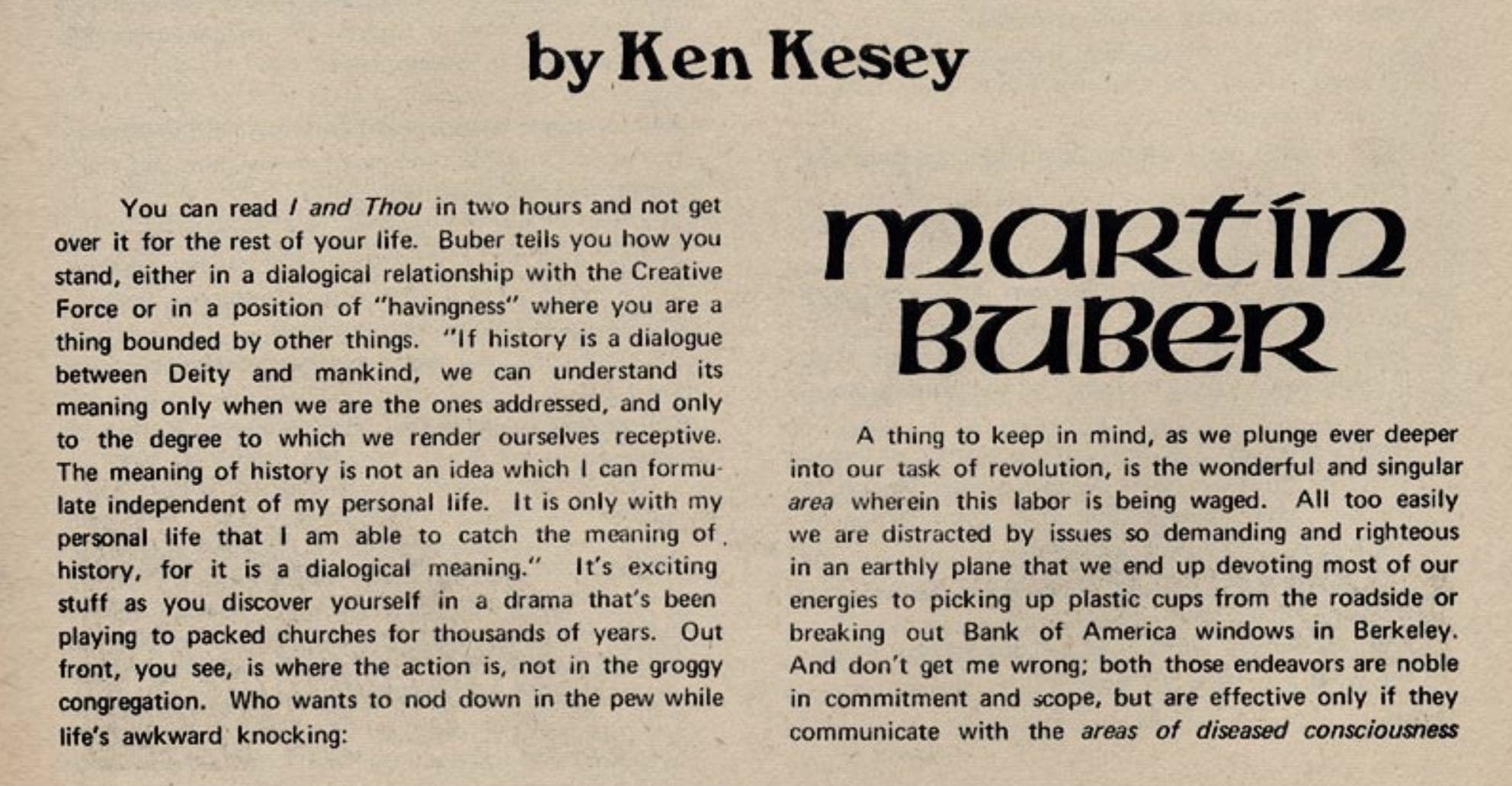
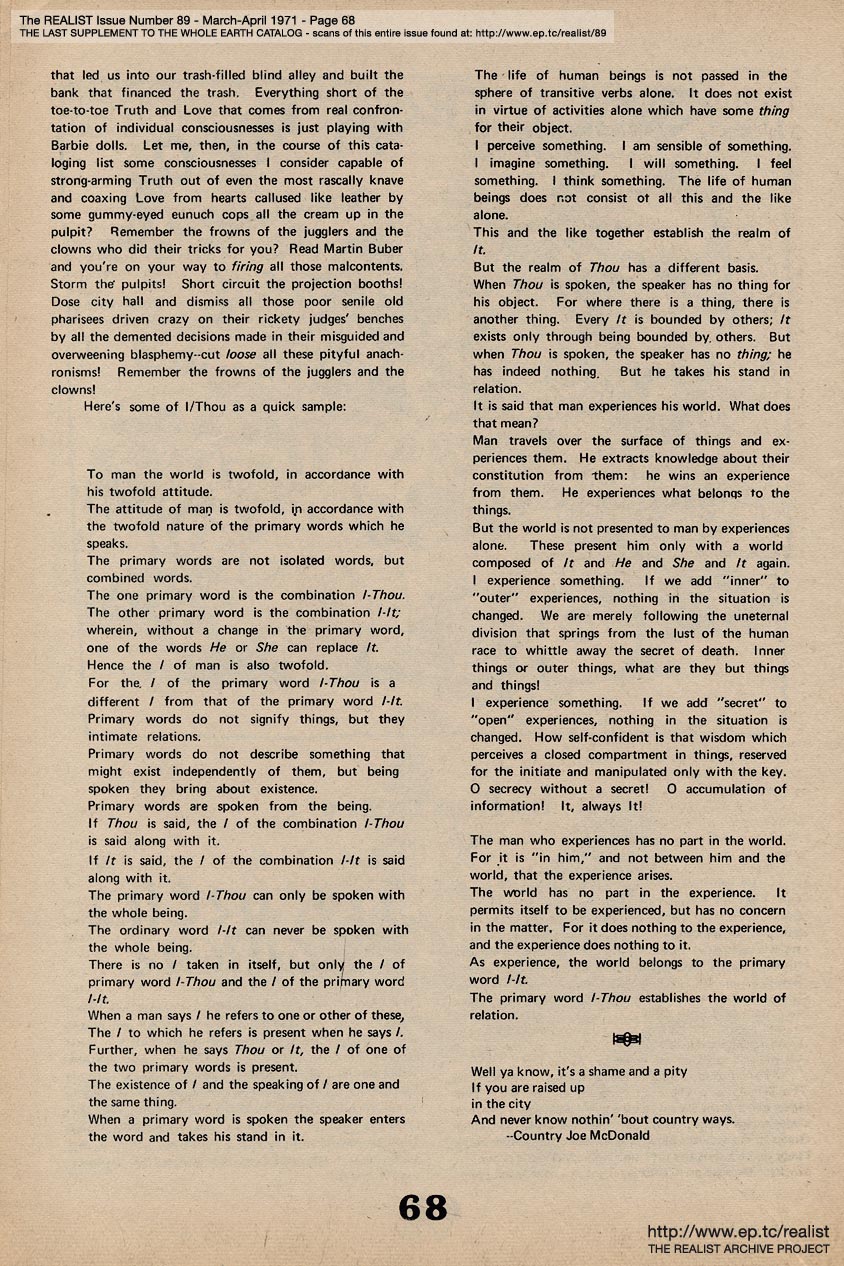
- Notes on Kesey commentary
- local political action, well sure, ok, but only if it "communicates with the area of diseased consciousness"
Everything short of the toe-to-toe Truth and Love that comes from real confrontation of individual consciousness is just playing with Barbie dolls.
- This is a very 60s idea, that the way to real relationship is via "confrontation". I guess I vibe with that intellectually, given my self-identification as a conflict theory guy. But I don't have the right social skills or environment to practice it. Have been searching.
- From JFM (not sure where but logged Mar 21st, 2025)
Buber’s I-Thou is sometimes taken as a kind of anthropotechnical heuristic: “Look what happens when I choose to approach this It as a Thou.” But this is not what Buber means. What he means is that there is a modality in which things reveal themselves as always-already Thous, such that they thereby transcend any reduction to physical or instrumental ratios we might subject them to. This dimension of things is as real—and more fundamental—than the realm of I-It, which recognizes personhood only at the subject end of a relation. If we use “metaphysical” in the colloquial sense of “beyond physics, i.e. spiritual,” then I-Thou is intrinsically metaphysical. That Shinto approaches this divine dimension of the world as an immanent one is laudable, because it allows for a modal dualism where there might otherwise have been a substance dualism, as in Descartes and many forms of Protestantism. However, I would argue that the sacramental cosmos affirmed by orthodox Christianity is very much like Shinto on this point.