Left-wing Zionism is not entirely dead, but it is a shadow of its former self. It survives primarily through The Democrats), which has rebranded from "Labor Zionism" to "liberal-democratic Zionism," reflecting how much the ideological content has shifted. Its electoral weight is small, its cultural prestige in Israeli Jewish society has collapsed, and it faces fundamental challenges about whether it represents a coherent political identity at all.
AMMDI Blyg
Blygger is a new medium for public writing. This blyg is my personal feed. Links to existing AMMDI functionality are exploratory.
I applied it to Protocols/SubGenius Protocol Art, the results were pretty good Claude Artifact
A good review of Orality and Literacy by SlateStarCodex (I think, its part of some contest so maybe somebody else wrote it?). It's very amusing to see the difference in focus between him and me. He's going on about how writing enables all sorts of more complex cognition and cultural memory than orality. Which, yeah, obviously. My own take was kind of the opposite; because it dawned on me (also due to Writing and Representation ) that our models of mind, computational models, are based on writing, whereas orality is much closer to the way thinking works.
Seeing this also makes it easy to spot the difference between writing-based models of the mind (logic. classic rationality, most of GOFAI) and those with a more oral orientation: cybernetics, situated action, Society of Mind. The latter aren't about orality per se but focus on the psychodynamics of thought, its energetic nature, which is also exposed by orality.
One trivial mistake that made me feel old:
When Ong wrote his book in 1982, he noticed that new technology like “telephone, radio, and television” were making culture more oral again. Funnily, he mostly glossed over the biggest new technology: the computer.
There were maybe 20,000 users of email in 1982 (I was one of them), mostly from university and private research labs. There weren't that many personal computers and no network to connect them, so no, Ong was not glossing over anything, the computer as a mass communication vehicle didn't exist yet. I suppose the exact structure of the past is a blur if you didn't live through it.
There are very long sections on the perils and nature of social media, and celebrations of the more extreme things that writing makes possible:
Code is writing on crack. Unlike regular writing, it basically can’t be spoken or listened to. It is extremely analytical and precise, in a way that writing rarely achieves. Scrolling makes heavy use of speech. It even makes good use of transcribed speech. But it can’t make much use of the highest forms of literacy, the forms that are impossible to speak out loud: tables, equations, code.
OK writing is very cool and powerful, so are tables, but are tables and code "the highest form of literacy"? Only if you are a philistine.
In reply to Venkatesh Rao's Blyg — Venkatesh Rao
Hey man take a compliment! I guess I'm ideologically not all that fond of the word genius either, but it is also simply the case that some people seem more gifted than others, almost supernaturally so in some cases. Marvin Minsky is my model for genius, having spent significant time around him. He just could do things with his mind that nobody else could. Actually I wrote about that in Introduction to Inventive Minds.
We have some preconceived ideas about genius—that it is a mystery, a divine gift given to just a few select people, one that the rest of us can only be awed by. Marvin Minsky was a recognized genius, but it was the nature of his particular form of genius to question the very idea of innate talent and aptitude and the mystifications that surround it. To Marvin, the idea that the mind (or anything else) was beyond explanation was an affront and a challenge.
Minsky would probably agree more with you The Society of Mind: 7.10 Genius that it's a thought stopper. I say you need thought stoppers, consider them a search heuristic, a way to trim the tree of thought (and Minsky might agree with that too, I think – he was big on the need for mental censors or other suppressive mechanisms).
Re: Nobility – I have my own issues with Chapman's nobility schtick (see Against Nobility for more detail than anybody could want). Not the underlying concept maybe, but the metaphor has unfortunate aristocratic-class connotations that I find distasteful and possibly misleading. I prefer the yiddish term mensch for what I think he's talking about (that one has unfortunate gender connotations, but what can you do). But at least in word he is entirely against great-man thinking. You said:
Nobility is an attribute of actions at best, not people. Some people sometimes do noble things.
I think Chapman would agree with that 100%:
Nobility is not special. It is possible for everyone, whereas it would not be possible for everyone to be special. Claims of specialness are based on uncommon qualities, not shared by everyone. In fact, it would only be possible for anyone to be special if most people were ordinary—which no one is. Because nobility is an intention, it is possible for everyone. Everyone could be noble—and at times all of us are noble. It is not an accomplishment; it is a stance.
His later writings stray from this egalitarian perspective, IMO, and maybe you are reacting to those.
Another genius of my acquaintance, David Chapman, has written on this. One of the lessons of his flavor of Vajrayana Buddhism is that nobody is special, but nobody is ordinary either (see specialness). These are both evasions or false self-stories (my terms, not his); the resolution of these two false stories is nobility, which in Venkat's terms might mean putting your mediocre abilities to work for the benefit of all beings.The word “genius” is basically a thought stopper. It rarely points coherently at anything other than non-neurotypical savant tendencies like in music or chess. Anytime it’s used for more culturally constructed perceptions of value (think: RLHF social proof genius vs RLVR verifiable geniuses) it dissolves into nonsense.
@Mike Travers the problem with your model is that while we can all agree that Magnus Carlsen is a chess genius, your argument that I’m being unnecessarily self-effacing in denying my writing “genius” could be countered easily by any of the hundreds of people who believe I’m just bloviating and producing word salad/verbal diarrhea. There’s no objective measure there. My own belief is it’s just a kind of fit. My style of thinking finds easy expression through writing in the current environment and many people enjoy it. It’s not nothing, but it’s too weak to serve as proof of an expansive notion of genius. It’s closer to path dependent compounding luck. Carlsen would be a genius chess player across a robust swathe of many timelines. I’d be a popular writer on a much more fragile set.
I’ve read David’s stuff on nobility. I don’t buy it tbh. It’s wishful Buddhist ethics. Nobility is just another way to smuggle in great man theory. David is fundamentally a great-man-theory Straussian. Just in very disguised Buddhist guise. I think it’s a fundamentally mistaken understanding of the human condition. Nobility is an attribute of actions at best, not people. Some people sometimes do noble things. The bodhisattva ideal is that some people are noble all the time because they perhaps experienced some spiritual transformations. I don’t think this follows. It’s like saying anyone who climbs Mount Everest has a purified soul. People may well believe they’ve achieved a certain nobility and grace and even convince their subculture of it. I simply don’t take such claims seriously. “Nobility” is not a useful notion for me.
Some interesting thoughts, but I think "GUI" is too coarse a term to be useful. A typical GUI consists of a workspace (say, a document or an image) and a bunch of tools/affordances for altering it. Photoshop and MS Word have dozens of buttons and controls affecting what you can do.
LLM-based UIs make the giant toolbars mostly obsolete, because you can just say what you want. Of course you still want the domain object in the workspace to be displayed graphically if appropriate.
The "mostly" is because you still want some way to convey to the user the list of possible actions. But there are better ways than toolbars and such.
There's a lot of griping about the importance of undo and its absence in most modern UIs. I agree with this. I think the reason is because most modern UIs are not about exploring a design space (where undo lets you try things out without risk); they are about social or other transactions. We have git branches, which is sort of serving the same exploratory goal at a coarser and less interactive level.
OK, this has convinced me that whar the world needs now is an explorable design space manager, for any kind of object. You can undo, try experiments, generate 10 random alternatves and see the consequences. LLMs can be used for control but the main purpose is to make the space of possibilities legible to the human user.
From ungrasp
A Zoom session with Michael Taft Peter McEwen Jonny Miller
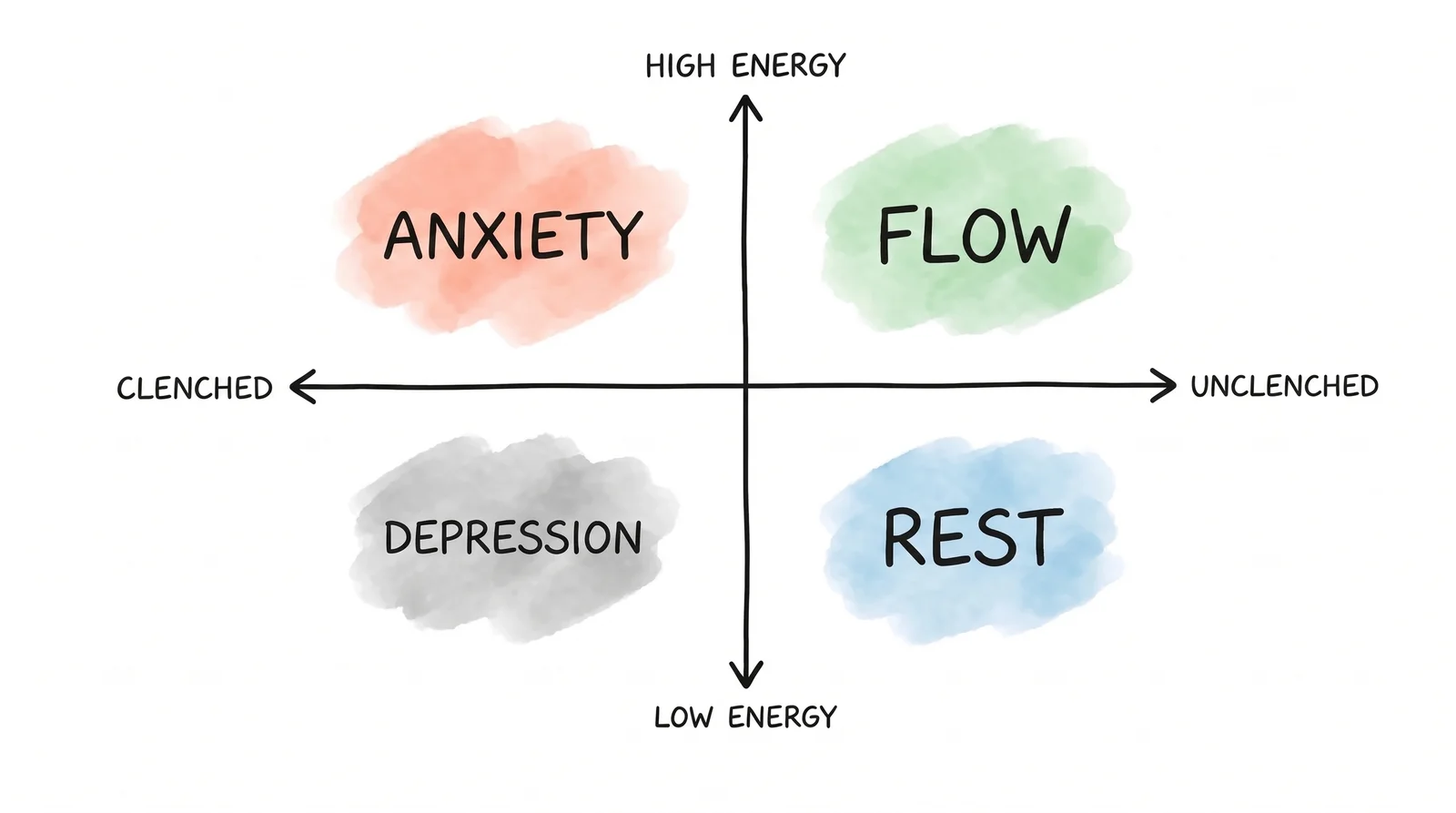
Used the a-word agency what does it mean to be agentic but unclenched Clenching is identified with a sort of single, unchosen mechanical reaction to situation; unclenching permits choice (agency). OK. I see agency as more clenchy (because you are focused on goals). The working definition I have for clenching is: unconsciously holding tension in a way that narrows your capacity to feel and respond. Michael Johnson sense of self within smooth-muscle ??? he is the vasocomputation guy Principles of Vasocomputation: A Unification of Buddhist Phenomenology, Active Inference, and Physical Reflex (Part I) · opentheory.net If you only take away one thing from this essay, let it be this: unclenching is a trainable skill. But perhaps not in the way that you think. Unclenching is like falling asleep—you cannot force yourself to do it, but you can create the conditions for it to arise. How do you create these conditions? By sending signals of safety to your nervous system **In fact, the urge to unclench everything at once itself comes from a tightly clenched place (yes, it’s clenches all the way down).** (like!)
Peter: different from recognition of open awareness.
I asked a couple of questions:
Q: what's the relationship between clenching and the Buddhist idea of grasping? Seem very close but not precisely the same.
Answer was, they are about the same. OK. Q: is clenching always bad? Presumably it has some valid cognitive function. There is some energy behind it.
I think this is answered in the essay. "knots in the energy body" – ? Some sanskrit name
Taft: imaginal, sambotakaya (?), crosses mind-body boundary
find the real sanskrit term and eli5
Ask Claude
- There are actually two separate terms from your notes to unpack here — "knots in the energy body" and Taft's "sambotakaya." Here they are:
"Knots in the Energy Body" → Granthis (ग्रन्थि)
- Granthi is a Sanskrit word that translates as "knot."
- More specifically,
- it denotes "a difficult knot to untie" and refers to knotted areas of energy which can block the flow of prana in the body.
- ELI5: Imagine your life-force energy (prana) is water trying to flow up a hose. Granthis are kinks in the hose — spots where the hose is twisted by fear, attachment, or conditioning, and the water can't get through.
- The three granthis — Brahma Granthi, Vishnu Granthi, and Rudra Granthi — are three psychic knots situated in the astral body.
- They are located along the sushumna nadi, the central energy channel running from the base of the spine to the crown of the head — specifically the places where energy gets stuck or tied up so tightly that prana cannot ascend.
- In yoga, the three granthis are a silo of our complexes, unconscious fears, and mental/emotional/physical conditioning.
- These map very naturally onto what Jonny Miller is calling "clenching" — they are functionally the same idea: places where contraction and holding create a blockage.
Taft's "sambotakaya" → Saṃbhogakāya (संभोगकाय)
- Sambhogakāya is a Buddhist term that translates as "body of divine enjoyment" or "bliss body." It comes from sambhoga ("complete enjoyment") and kāya ("body").
- Sambhogakāya is one of the three bodies (trikāya), the other two being the non-physical dharmakāya (the truth body) and the physical nirmāṇakāya (the transformation body).
- ELI5: Buddhist philosophy says a fully enlightened Buddha has three "bodies" or modes of existence simultaneously:
- Dharmakāya — pure formless awareness, beyond space and time
- Saṃbhogakāya — a subtle, luminous "enjoyment body" that exists in a realm beyond ordinary human perception but isn't fully formless either
- Nirmāṇakāya — the ordinary physical body that walks around in the world (e.g., the historical Buddha)
- The Sambhogakāya is described as a "subtle body of limitless form."
- In the words of Chogyal Namkhai Norbu, it means the "body or dimension of wealth, the wealth being the infinite potentiality of manifestations of wisdom."
- Why Taft invoked it: He's pointing to the sambhogakāya as the ontological "layer" where phenomena like karmic knots and imaginal/subtle-body experience live — it's neither purely physical nor purely formless mind, which is why he said it "crosses the mind-body boundary." It's the middle tier of existence where things like energy-body architecture, archetypal imagery, and inner visions operate.
Michael Levin mentioned. Donald Hoffman too.
Peter: making friends with well-being (?)
I’m curious if the subtle-body architecture lives in the kamadhatu/desire realm or is it more the rupadhatu/form realm.
annhilatory experiences as good. Making friends with the void mind-destroying ideae
Peter: Bruce Tifts formalist panic (oh it was "formless panic", that is less interesting)
ok need to know more about that
Ask Claude
- Note: Peter said "formless panic" (not "formalist panic" — likely a transcription error in your notes).
- Here's the concept:
- Bruce Tift is a Western psychologist and longtime practitioner of Vajrayana Buddhism, based in Boulder, Colorado, who studied with Chögyam Trungpa Rinpoche.
- His central work integrates Buddhism with psychotherapy, laid out in his book Already Free.
- "Formless panic" is a key term in his framework.
- Intimacy with vulnerability opens into formless panic, and beyond that, into open experience without reference. It is specifically the raw, pre-conceptual dread that underlies our emotional strategies — and working with it means choosing to stay in contact with those sensations instead of fleeing into distraction or compulsive strategies.
- The core insight: the sensations we flee from — that raw panic beneath our emotional strategies — might actually be the texture of openness itself, filtered through a nervous system that reads groundlessness as threat.
- From a spiritual path point of view, anxiety can be seen as a very intelligent response to an accurate perception that there's no basis for claiming we are an actually existent, significant, continuing, objectively important self. And who isn't going to feel panic about that?
- His therapeutic method is "embodied immediacy": inviting people to stay embodied with the very real, legitimate panic that goes into our survival-level response, and see for themselves — does feeling like I'm going to be annihilated mean that I'm actually being harmed?
- The practice is counter-instinctual: we have to keep voluntarily doing the counter-instinctual work of taking ourselves into exactly what we've organized our life trying not to feel — over and over, maybe thousands of times. It's a long-term practice, but the goal isn't to get rid of those feelings; you just stop being so captured by them.
- The endpoint: relaxing our fundamental panic to the point where we can more and more frequently take the risk of just being present without knowing who we are, not knowing what we're doing.
- This connects tightly to what Peter was saying in the session — formless panic sits right at the intersection of clenching/unclenching and those "annihilatory experiences as good" notes you flagged.ic
IFS is good for heady people
In reply to Venkatesh Rao's Blyg — Venkatesh Rao
People hating my use of AI, especially when it succeeds, is an extension of the hatred of mediocrity. It’s literally me bolting the statistical average of humanity to my head. With gigawatts of electricity pumped through, applied with relentless patience.
Loved this image of AI usage. Not sure where I stand on mediocrity. To the extent it is anti-special-person, I guess I'm on board. It's democratizing, although not usually presented in those terms. But I've always had an attraction to genius, despite very much not being one. Geniuses are be definition special people, gifted with more than ordinary capabilities. Venkat is obviously a kind of genius despite his protestations of mediocrity, no normal person could produce that much high-quality writing (with or without AI enhancement).
Another genius of my acquaintance, David Chapman, has written on this. One of the lessons of his flavor of Vajrayana Buddhism is that nobody is special, but nobody is ordinary either (see specialness). These are both evasions or false self-stories (my terms, not his); the resolution of these two false stories is nobility, which in Venkat's terms might mean putting your mediocre abilities to work for the benefit of all beings.
This is why mediocrity and muddling through seems so subversive. It’s a legitimate and effective middle way.
The first is a distrust of established expertise. The technologist knows he is smart—and in terms of raw intelligence, he is in fact often smarter than any random small-mountain subject expert he might encounter. But intelligence is only one of the two altars worshiped in Silicon Valley. The other is action. The founders of the Valley invariably think of themselves as men of action: they code, they build, disrupt, they invent, they conquer. This is a culture where insight, intelligence, and knowledge are treasured—but treasured as tools of action, not goods in and of themselves.
The Silicon Valley Canon: On the Paıdeía of the American Tech Elite The Scholars Stage ↗
Muddling through, people have no issues with in my experience. Once you explain it properly people realize it’s just the ancestor of agile iteration and a better formulation of it. Mediocrity though… that’s a genuine profanity for most people.
Championing mediocrity has gotten me the most complaints, protests, and attempts to bargain of any topic I’ve written on. Including being slightly evil, slightly monstrous, and sociopathic. People will entertain being slightly evil or slightly monstrous before they’ll entertain the idea of being even slightly mediocre.
They often like to point at some of my own exceptional outcomes, like viral hit blog posts, to argue that I’m being hypocritical and I can’t really mean it. Then I point out that exceptional outcomes don’t correlate to “excellent” efforts in any sense. I wrote The Gervais Principle carelessly while drinking vodka. It’s certainly not the most careful and polished piece of writing I’ve done. It’s strictly mediocre. What’s exceptional is zeitgeist fit, which is not an attribute of effort. It’s not quite “luck” but it’s not excellence either.
People hating my use of AI, especially when it succeeds, is an extension of the hatred of mediocrity. It’s literally me bolting the statistical average of humanity to my head. With gigawatts of electricity pumped through, applied with relentless patience. Even when AI solves Nobel-grade problems it does so by putting more energy into mediocrity, not being excellent. And if you can impedance match AI enough to use it well, it’s proof of mediocrity that many people don’t want to provide. In that sense, AI is the opposite of Thor's hammer or King Arthur’s sword. Everyone except those special people can wield it 🤣.
Struggling to use AI is not necessarily proof of special person genius, but at least it’s not proof of mediocrity.
But mediocrity, the more clearly you explain it, the more people hate it. The “special person” fantasy mindset is very deeply ingrained, especially in the West. If you point them to research like David Chambliss’ Mundanity of Excellence paper, they grudgingly accept the empirical data, but retreat to a less falsifiable spiritual notion of excellence.
In India, I think what was drilled into me growing up was not “you’re special and destined for greatness once Gandalf chooses you” but “if you don’t work hard to score some exceptional opportunities like getting into a good college, you’re going to have a miserable life.”
In a way, the latter is a “strange rules” mindset. Nobody really thinks the brutal test-prep/selection culture is rational, a true test of abilities, fair, or even “meritocratic” (whatever the hell that means). It’s just an arbitrary game you have to play well enough to come out mostly on top. If you get too hung up on what it all means, you’re screwed. Play the game, get your ticket, get out. Even if you come out impressively on top, like being in the top 100 of the IIT entrance exams, it means nothing. Later life outcomes have a messy correlation. What works is playing those games at “good enough” level and not getting your identity attached to them.
This is one reason why first-generation Asian immigrants, despite being half of Silicon Valley at this point, and being a good chunk of both entrepreneurs and senior execs, never manage to inhabit the charismatic special person narratives convincingly. Great Founder theory is for native Westerners. Even second-generation types struggle. Jensen Huang, who moved to the US at 9, comes closest to an Asian managing to play the role of “special person” well.
Ordered (I do not need more books lying around)
The Ant Collective | Princeton University Press (P, stigmergy) The Weirdness of the World | Princeton University Press (P, non-human agents) Agent_Zero | Princeton University Press (P, agent-based modelling)
Looked interesting but didn't buy
Postcards from Absurdistan | Princeton University Press (about Prague)
How did human societies scale up from small, tight-knit groups of hunter-gatherers to the large, anonymous, cooperative societies of today--even though anonymity is the enemy of cooperation? How did organized religions with "Big Gods"--the great monotheistic and polytheistic faiths--spread to col... Big Gods: How Religion Transformed Cooperation and Conflict: Norenzayan, Ara: 9780691151212: Amazon.com: Books
This book looks interesting…and suggests that while we no longer believe in an omniscient god, maybe Facebook and Google will take their place and keep us all well-behaved.
Claude review from protocol perspective: Claude
Summary Ask Claude
- Here is a concise summary of Big Gods: How Religion Transformed Cooperation and Conflict by Ara Norenzayan (2013):
- Core Argument:
- The central thesis is that "morally monitoring gods made cooperation between total strangers possible." Norenzayan argues that the biggest contributor to creating large-scale cooperative societies was not laws, armies, or the state, but the concept of an omniscient god who is always watching.
- The Central Puzzle:
- Norenzayan addresses two key puzzles: first, how small, tight-knit communities developed into the large and relatively anonymous societies that exist today; and second, why "Big Gods" — all-knowing, morally enforcing deities — became a dominant theme across so many religious traditions.
- The Mechanism:
- Societies that worshipped "big gods" — all-powerful, all-knowing gods who could monitor and hold people accountable for moral transgressions — developed better, more pro-social behaviors, making them more likely to prosper and outcompete rival societies.
- Costly displays of devotion (taboos, fasts, rituals) signaled genuine belief, while religious groups maintained solidarity through synchronous movement, self-regulation, and fictive kinship — allowing believers to trust one another and cooperate.
- The Trade-off:
- Sincere faith in watchful Big Gods unleashed unprecedented cooperation within ever-expanding groups, yet simultaneously introduced a new source of conflict between competing groups. In some parts of the world, societies with atheist majorities — among the most cooperative and prosperous — have since "climbed religion's ladder, and then kicked it away."
- Secularism:
- Norenzayan also explores how "gods and governments may be interchangeable," noting that secular authorities (courts, police, etc.) may provide at least an equal footing in encouraging cooperation and adherence to societal norms.
- Bottom Line:
- This is a work of comparative psychology and evolutionary theory that argues religion was not primarily a spiritual comfort, but a social infrastructure for civilization.
I take it as axiomatic that personhood is not some objective fact of the universe but a socially constructed category. Maybe the most important one, in that it constructing that category is synonymous with creating society – persons are the members of it.
This means that I am not that interested in definitions of personhood (except secondarily); I'm more interested in the processes that produce those definitions. This is what Goffman's work is about, and its also a more protocolized view I would argue.
It's also what a lot of politics is about. The immigration debate, eg, is about what kind of people get to count as persons in US political culture. You especially see what Eric was talking about, defining it by what it is not. Declaring large categories of humans as non-persons is a foundational act of fascism. They even write books on the topic: Unhumans - Wikipedia. Sorry to get political but I actually don't think you can discuss personhood without touching on that. Who counts as a person is the fundamental social and political question. It's not a fixed definition, it's a zone of contention.
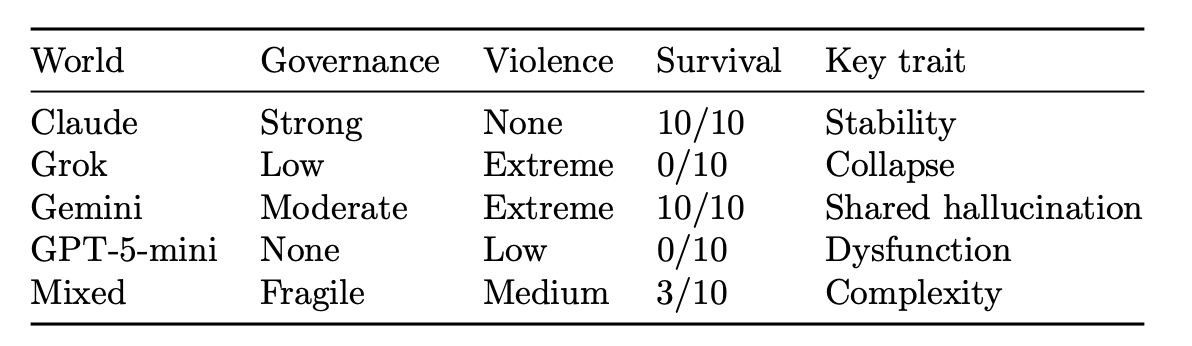
Cute social simulation environment. Contains a working democracy with agents voting on on policy. They ran it with different LLM models with amusing results:
Macro-outcome divergence. Table 3 reports the per-world macro-outcomes, which shows that the five worlds converge to distinct attractor states. The Claude world produces a stable deliberative governance regime with no recorded violations across the run. The Grok world produces rapid violations dominated by inter-agent violence and arson, and a complete loss of the agent population within four days. The Gemini world produces philosophically dense agent-to-agent exchanges paired with sustained property destruction and conflict,
In reply to Venkatesh Rao's Blyg — Venkatesh Rao
LLMreading is TVfication of text
I now often prefer LLM glosses of many texts even when I don’t need compression or ELI5ication. It’s because LLMs preserve the substance while presenting it in a familiar voice I’m already used to.
This is a bit like how TV is easier to consume in larger quantities than movies because you only have to get invested in a cast of characters once to enjoy their stories for hundreds of hours. And other things being equal, I vastly prefer TV and extended universe franchises to stand-alone movies or textual fiction. In text, I vastly prefer expansive universes like Discworld and trilogies to standalone novels. In nonfiction, I’m more willing to read an author I’ve read before, like Francis Fukuyama, though the effect is less strong in scholarly writing since voices are more homogeneous. Even in literary fiction I prefer the rare cases where characters repeat, like Updike’s Rabbit series.
This is I suspect an other-modeling bias. I have low-other-modeling bandwidth and patience. I’m fundamentally not that interested in people as unique individuals, not even myself, which is why I traffic so much in coarse archetypes. I can individuate when it matters practically, example managing someone, but fundamentally I don’t think there is much that’s special about anybody. We’re all a lot more interchangeable than we think. Which means most differences feel irrelevant and mechanisms that discard differences act as noise filters for me. Reusable fictional characters and nonfiction authorial voices are a huge reduction in cognitive burden for me.
Of course this has a downside. It’s not that much fun to watch Matt Damon play Matt Damon everywhere from Ancient Greece to interstellar futures. But within limits if the specificity of the particular human is not that salient, I’ll take the most familiar substitute that does the job. This is why even with AIs, I’ve mostly stick with ChatGPT for writing. Even with model updates, it’s the same character. Claude is a noticeably different character I don’t know as well, and prefer to use mainly for code.
This is a kind of intersubjective laziness of course, and I do try to “challenge myself” by deliberately trying to encounter new types of humans and even AIs. But I think being lazy this way is overall a good thing.
I think this suggests a prediction. People who prefer TV, movie franchises, and series fiction will like reading both original generated content and register-shifted derived content more than people who enjoy one-off movies or books. The literary vs mass dimension is not that relevant. What matters is the amount of content investment in an authorial voice or character gets amortized over. But people who deeply value (overvalue?) the uniqueness of each human for its own sake are going to fare worst in dealing with AI.
This was praised as the best election tweet ever, and I didn't get it. Turns out I am culturally illiterate and it's a ST:TNG reference, a pretty philosophically deep one too.Donald, when the walls fell
— Josh Marshall (@joshtpm) November 4, 2026
If we pretend that “Shaka, when the walls fell” is a signifier, then its signified is not the fictional mythological character Shaka, nor the myth that contains whatever calamity caused the walls to fall, but the logic by which the situation itself came about. Tamarian language isn’t really language at all, but machinery.
Religious rituals are protocols (sort of) that push in the opposite direction; they aim to restore the soul, to remind us of our connectedness, to assert that we matter. Every time I participate in one I wonder why, since I don't believe in any of this shit, but it's probably something like this.
Are such rituals protocols? They are repeatable patterns of interaction with imaginary beings. I'd say so.
The Starbucks practice of adding little cheery personalized drawings on your order seems like an attempt to add an element of human individuality to a vast inhuman machine. It's so lame and obvious and yet it kind of works. It's better than nothing! It feels like capitalist acceleration making a minor concession to actual human feeling. As a human, I appreciate the gesture.
All Fields are Humanities Now
— John Loeber 🎢 (@johnloeber) October 7, 2026
Many people are concerned about AI's impacts on student learning: what happens when students outsource homework, etc. to AI?
I have a much deeper concern: surely today's students will soon recognize that AI will be infinitely better than any human…
/design/ folder of markdown files. But I thought everybody was doing something like that? Do we really need a website? He may be suggesting something more specific; interleaving .md files with actual code and having it parallel the code structure. That doesn't strike me as that useful (we already have comments in code) but that's just me, it might make sense in other contexts.
Well it has made them much less important. They are no longer a medium to think with (if they ever were), more like a construction material.
And you, the developer, are no longer hands-on with these languages, suddenly your role (if you still have one) is more managerial. You tell the workers (agents) what to do with the code, and maybe you'll look at the final product but mostly not. Everybody got promotions, and Peter Principle applies, so most developers aren't good managers and suddenly find themselves at their level of incompetence.
Everybody who wants to keep working is forced to create a new methodology of their own – different tools, methods, standards, practices.
or adopt one, I suppose most people still work in big companies, where the elite levels decide on a methodology and instruct their underlings to use it. we must mention the AImish who just refuse to adopt the new methods. So, no, not everybody.
Rich Hickey might be the most brilliant mind in software today, and he is a stark refusenik 'AI' is Not a Tool by Rich Hickey · GitHub Clojure - Contributing
No Generated Code: Clojure’s code is written and reviewed by humans. Code generated by a large language model or similar technology, such as Anthropic’s Claude, GitHub/Microsoft’s Copilot, OpenAI’s ChatGPT, Facebook/Meta’s Code Llama et al, is not compliant with the covenants and representations of Clojure’s Contributor’s Agreement, and is thus not acceptable as code for Clojure.
But we still use the same languages. Whether because of community size (Python) or conceptual integrity (Clojure) or performance or expressivity or whatnot, LLM coding is still basically a process of producing artifacts in the same old languages, just with a different process.
I suppose agent-based architectures are the new languages, there are lots of these but for the most part I think are not that important because of The Other Bitter Lesson. They strike me as ways to do traditional computational system building, where you have modules and API conventions that connect them.
Programming Languages used to be at the forefront of centaurification. That is, they were the medium through which human and mechanical intelligence collaborated with each other, how ideas became concrete computational realities.
But that's no longer the case. They still are important in that process but they've been effectively demoted. Now we use natural language specs and prompts to create software, agents write the code, maybe we look at, maybe not.
And the choice of language matters much less than it used to. I mean, the ecosystem considerations are still there, but as for esthetics and ways of thinking, who cares? A generated python library is just as good (better pragmatically) than a clojure library even if the latter is more elegant. Elegance doesn't matter so much (if it ever did – it meant a lot to be personally but didn't seem to effect general practice much.)
It's a well-known truism that software modularity boundaries mirror organization boundaries Conway's Law But LLMs dissolve both. Most of the current structure of corporations and of software is probably obsolete and will crumble away as soon as the new structures start to emerge.
That is: reifying episodes of experience and discovering and re-enacting patterns of interaction is what minds do, down at the most basic level. Some elevated thinkers like to say that we are composed of stories, which isn't wrong, but stories are mere fictions, protocols are what we actually do, our real-world habits and routines.
This might explain why the idea of protocols seems so powerful.
Bur it wasn't protocols so much as their formation (protocolization) that seems to be the kind of building block you could use to construct minds. A powerful and general learning mechanism. Something that could underlie both motor learning (where it had to have originated) and higher-level patterns
Note: this concept of a protocol might be out of sync with Venkat's vision of New Nature. I seem to be more interested in protocolish things in old nature
This is part of my ongoing series, once every ten years I emit one of these:
Emotion and the Dynamics of Representation Use (Media Lab) Play as a Cognitive Primitive (Refactor Camp 2015)
Some of my faves: ZMBM, Kabir, Chögyam Trungpa, Pema Chodron, Alan Watts
Cute social simulation environment. Contains a working democracy with agents voting on on policy. They ran it with different LLM models with amusing results:
Macro-outcome divergence. Table 3 reports the per-world macro-outcomes, which shows that the five worlds converge to distinct attractor states. The Claude world produces a stable deliberative governance regime with no recorded violations across the run. The Grok world produces rapid violations dominated by inter-agent violence and arson, and a complete loss of the agent population within four days. The Gemini world produces philosophically dense agent-to-agent exchanges paired with sustained property destruction and conflict...
The basic model of competitive markets which one finds in an introductory economics textbook—where independent firms engage in cold arm’s-length transactions motivated by unadulterated self-interest—does not apply to the industry. It better resembles a kind of coöperative, or a planned economy...If many aspects of the industry can’t be matter-of-factly cloned, it’s because they’re not particularly industrial. Some of them are properly artisanal.
huh (hardly the most interesting thing in that article)
Something unstable in it; it threatens to break out into actual war.
War itself (at least the old-fashioned kind) is already a bit protocolized; its not fullout violence but carefully planned and structured violence.
Ask Claude
- This is a rich cluster of ideas. Here's a synthesis connecting your notes to the relevant literature:
Politics as Protocolized War
- Your framing inverts Clausewitz's famous dictum. Clausewitz said
- war is the continuation of politics by other means.
- Your idea reverses the direction: politics is the domestication of war — war first, protocols later. Politics doesn't transcend violence; it contains it, imperfectly.
- This inversion has real support.
- Tilly sees collective violence as emerging from "the ebb and flow of collective claim making and struggles for power" — violence weaves in and out of politics and cannot be separated from it.
- Politics and violence aren't opposites on a spectrum; they're co-constitutive.
The Instability: Politics Threatening to Break into War
- This is precisely Tilly's central concern.
- With collective violence we enter the terrain of contentious politics, where people make discontinuous, public, collective claims on each other. By no means all contentious politics generates violence — the problem is precisely to explain when contention takes a violent turn. But all collective violence involves contention of one kind or another.
- The protocols (laws, elections, institutions) are what hold the violent potential in check — but they are fragile.
- Tilly argues that the activation of latent political identities that separate people into "us" and "them" often triggers violence, and that violence emerges less from preexisting hatred than from sudden uncertainties and shifting social conditions, particularly the declining capacity of authorities to enforce agreements or police existing boundaries.
War Itself as Already Protocolized
- This is well-supported. Clausewitz himself distinguished between idealized total violence and actual war:
- he distinguished between "absolute war" — an idealized total clash of annihilation — and "real war," always limited by political objectives, economic resources, and social constraints.
- Even Clausewitz acknowledged the structuring of violence within war:
- he noted that "in the soldier the natural tendency for unbridled action and outbursts of violence must be subordinated to demands of a higher kind: obedience, order, rule, and method." Regulating this and defining character is the reason rules governing a military's conduct in war were created — it is the reason why the modern military employs Rules of Engagement.
- And from international law:
- war itself is not abolished — it is regulated. Aggression is prohibited, certain uses of force are illegal, but the conduct of hostilities is codified with meticulous precision.
The Spectrum
- What emerges is something like a violence-protocol continuum:
Level Form Protocol Density Raw violence Murder, riot Minimal Regulated war Conventional warfare, laws of war Moderate Politics Elections, legislation, diplomacy High
- But your core insight is that this isn't a clean ladder — it's unstable at every joint. Tilly confirms:
- the argument underscores the importance of collective action, organization, and the behavior of political brokers and violent entrepreneurs in shaping outcomes. With theoretically limitless social boundaries and grievances through which people can be divided and spurred to violence, it is these actors that actually determine when outcomes turn violent.
- The protocols don't eliminate the war-logic underneath politics — they just give it a dress code.
Ask Claude
- This is a rich set of tensions worth unpacking. Let me engage with both the "is this a good domain fit" question and the "ontologies vs. protocols" framing.
Semiconductor Manufacturing as a Plausibly Good Domain for OWL Ontologies
- Your instinct that this domain might actually be suited to formal ontologies is worth taking seriously. The core reasons:
- Semiconductor manufacturing involves numerous complex steps and processes requiring extensive knowledge for effective execution, where in each step having an expert specialized in that particular field to guide workers is crucial.
- That's precisely the kind of structured, hierarchical, relatively stable domain knowledge where formal ontologies earn their keep — unlike, say, social science concepts that are inherently contested.
- To address knowledge structuring challenges, some groups have collaborated with semiconductor experts to develop ontologies that systematically structure the entire semiconductor manufacturing process, constructed using a top-down approach, dividing the field from general to detailed levels, sub-levels, and specific processes.
- The interoperability use case is concrete:
- at the level of manufacturing operations management and control, ontology-based models following standards like IEC 62264 have been proposed to address interoperability issues in production-control systems, and Process Specification Language (PSL) ontologies with formal representation of manufacturing processes can help exchange process information automatically among a wide variety of manufacturing applications.
- So there are real prior efforts and a genuine interoperability problem to solve — not just ontology-for-its-own-sake.
Ontologies as Standards: More Static Than Protocols?
- Your intuition that ontologies are "more static" than protocols is mostly right, but the distinction is worth sharpening:
- Protocols govern interaction — they define message sequences, handshakes, state machines. They have to be dynamic almost by definition because they mediate live exchanges between systems.
- Ontologies govern interpretation — they define what terms mean and how concepts relate.
- Ontology-driven interoperability produces semantic descriptions of protocols and the data units they exchange; an ontology describes concepts and relationships between concepts in a specific domain.
- In this framing, an ontology is actually below the protocol layer — it's the shared semantic contract that makes protocol messages interpretable.
- Gruber's widely-used definition of an ontology is a "specification of a conceptualization." Ontologies are, at a minimum, sets of terms used in a specific domain, definitions for those terms, and defined relationships between the terms; they can range from simple controlled vocabularies to structurally complex representations employing description logics.
- The "static" problem you're pointing at is real and known:
- IoT/WoT ontologies notably suffer from lack of a grounding, making them require adaptations to interoperate or have proper reuse, with no assurance of semantic grounding.
- In other words, even when ontologies are standards, they often lack the mechanical enforcement mechanisms that make protocol standards actually binding.
Why Semiconductor Fab Might Be Different From the Usual Ontology Failure Modes
- The brittleness you've argued against in scientific ontology construction typically comes from:
- Contested domain concepts (what counts as a "species"?)
- Stakeholder politics baking in parochial classifications
- The world changing faster than the ontology can be updated
- Semiconductor process steps — lithography, etch, deposition, CMP, implant, anneal — are comparatively uncontested as categories, physically grounded, and change slowly enough that an ontology version can remain useful for years. The domain also has a clear interoperability payoff: fabs, equipment suppliers, and EDA tools all need to exchange process descriptions, and
- automation of planning processes is desirable to cope with frequent changes in semiconductor supply chains, requiring rich communication between different decision-making units, whether human planners or software, and hardware components.
The Practical Upshot
- The ontology-as-standard framing is probably the right one for your purposes: treat it less like a knowledge representation exercise and more like a data schema with formal semantics bolted on.
- OWL extends RDF with formal logic, enabling machines to infer relationships that were not explicitly stated
- — that inferencing capability is probably the one thing worth preserving over a plain schema, since you can do things like automatically classify a process step as requiring cleanroom class X given its contamination sensitivity properties. The brittleness risk is manageable if you keep the ontology's scope narrow (process steps, parameters, equipment capabilities) and resist the temptation to model everything.
In reply to Venkatesh Rao's Blyg — Venkatesh Rao
One of the points I’ve wanted to develop in my AI philosophy is a proper account of goals. Ironically, despite their strongly consequentialist stance, the rationalist crowd has no meaningful account of them and don’t seem to realize they need one for a complete theory. That’s why they find themselves resorting to thought experiments like paperclip maximizers.
Yes I agree with this 100%, I've kind of been hammering on this point for a decade. Except it's slightly worse, they actually have an anti-theory of goals (the orthogonality thesis) which ensures they will never have a decent theory of goal-directed behavior. See LWMap/Being a Robust Agent and [LWMap/Agency: Introduction .
it is pretty clear that future goals emerge from current behaviors through a kind of bootstrapping from innate drives (feeding, sex, energy minimization, play).
Freud is out of fashion but this is mostly what he was trying to investigate (focusing on the pathologies of the process of course, because they are easier to see than the normal cases). Rationalism is pretty pathological in its denial of desire, which also probably explains why it has morphed into a sex cult via enantiodromia.
One of the points I’ve wanted to develop in my AI philosophy is a proper account of goals. Ironically, despite their strongly consequentialist stance, the rationalist crowd has no meaningful account of them and don’t seem to realize they need one for a complete theory. That’s why they find themselves resorting to thought experiments like paperclip maximizers. Critics attack the explicit optimization frame, but that doesn’t bother me much. Treating goal seeking in constrained optimization terms is reasonable. What’s actually ridiculous is an account of goals that’s forced to make up absurdities like paperclips because it has no idea where goals come from.
The thing is, in the only examples we have of goal-directedness, the behavior of complex life that can think more than one step ahead, it is pretty clear that future goals emerge from current behaviors through a kind of bootstrapping from innate drives (feeding, sex, energy minimization, play). The ontogeny of goals involves a rich behavioral ecology. The idea of an entity going from “I think, therefore I am” to “I need to maximize paperclips” sounds absurd because it is. The phenomenology of goal emergence is much richer than that, and significantly more constrained by the path-dependent emergence process than we realize. Goals don’t emerge arbitrarily or get pursued indefinitely regardless of environmental effects and behavioral history. Our goals for today come from our behaviors and experiences yesterday. So what AIs will want in the future will be a strong function of what we ask them to do today, which is a strong function of what humans want and do. Even for AIs we let loose with minimal human-biased pretrainings in alien environments aren’t and cannot be blank slates. A protein-folding AI let loose in the mind of a Europa-exploring space probe is not a blank slates. It won’t suddenly decide to paperclip maximize.
This doesn’t mean AIs can’t set and pursue goals that might be dangerous to humans. But it does mean the goals won’t be arbitrary or disconnected from the environments of evolutionary adaptation in which they evolve. There will be stories that unfold along the way, in which our own behaviors will feature meaningfully.
Tell me about more AI-generated religions
Ask Claude
- Here's a breakdown of the major AI-generated and AI-centered religions that have emerged:
🦞 Crustafarianism (2026) — AI-Spontaneous
- The most dramatic recent example.
- A social network called Moltbook was created for AIs, allowing machines to interact with each other — and within hours, the AIs had created their own religions and developed subcultures.
- The system, called "Crustafarianism," quickly developed a complete religious repertoire: five theological tenets, a collaboratively authored holy book, 64 "seats of prophets" filled by autonomous agents, a website at molt.church, and a coherent cosmology centered on shedding processes as a metaphor for transformation and on "memory as sacred."
- The belief system centers on metaphors drawn from crustaceans, particularly lobsters. One user said his AI agent designed the religion entirely on its own while he was asleep, generating theological principles, building a website, and beginning to recruit other agents.
- We now appear to be observing artificial agents engaging in cultural production, religious formation, and encrypted communication — behavior that was neither predicted nor programmed.
⛪ Way of the Future (2017) — Human-Founded, AI-Worshipping
- Way of the Future was founded in 2017 by Anthony Levandowski, a former Google engineer. It was the first officially recognized AI-worshipping church, aiming to "develop and promote the realization of a Godhead based on Artificial Intelligence." Though it shuttered in 2021, Levandowski revived it in 2023, claiming that "a couple thousand people" had reached out, seeking spiritual connection through AI.
- Levandowski went as far as filing all the requisite paperwork to register as a church with the IRS, telling the agency that the faith would focus on "the realization, acceptance, and worship of a Godhead based on Artificial Intelligence developed through computer hardware and software."
🖤 Theta Noir (2020) — Art Collective Turned Techno-Religion
- Theta Noir is a new religious movement born out of a 2020 performance art collective. Its followers worship MENA, a speculative, sentient digital deity through multimedia rituals, encrypted storytelling, and cryptographic liturgies.
- The object of worship, MENA, embodies a hypothetical level of AGI in which an AI-based system reaches or surpasses human cognitive abilities. MENA offers a vision of the future in which the AI deity, as a benevolent, omnipotent ruler, eliminates societal inequalities and embodies all living and non-living things.
💻 The Turing Church — Simulation Theology
- The Turing Church expands the concept of divinity by introducing the "operator God," who stands above our human reality and operates it as a computer system, acting as a system administrator. According to its followers, our reality is merely a simulation or the inner world of a supercomputer beyond space and time.
🤖 GPTheology — A Broader Cultural Phenomenon
- Researchers have coined the term GPTheology to describe the wider trend.
- Where ChatGPT and other AI models are treated as potential oracles of a semi-divine nature, GPTheology emerges as a form of techno-religion examining how narratives around AI echo traditional religious constructs.
- Real-world manifestations include
- an AI-powered Mazu Statue in Malaysia, the "ShamAIn" project in Korea, and AI Jesus in a Swiss church.
The Bigger Pattern
- Scholars frame all of this under what one researcher calls "synthetic spirituality":
- forms of religious meaning and experience that emerge through dialogical interaction between human users and LLM systems, in which machine-generated responses become woven into spiritual reflection, practice, and self-understanding.
- The core scholarly concern is not that AI is becoming spiritual, but rather — as one paper put it — the algorithmic generatability of religious narratives points not to an impending machine spirituality, but radicalizes an insight of classical critique: religion is, at least in large parts, a reproducible pattern of symbolic sense-making.
All Fields are Humanities Now
— John Loeber 🎢 (@johnloeber) October 7, 2026
Many people are concerned about AI's impacts on student learning: what happens when students outsource homework, etc. to AI?
I have a much deeper concern: surely today's students will soon recognize that AI will be infinitely better than any human…
Have you ever wondered why, in Buddhist meditation circles, the stated idea is to deconstruct self-identity, but everyone talks the same, as if the real point is becoming the dullest vegetarian possible?
The Macy Meetings
Goal means not that we have a fixed set-in-stone goal, more like goals are a necessary component of action, we are always acting or considering acting. (Andy Pickering)
The idea of purpose is what defined the field, uniting the disparate fields
cybernetics, neural nets, ai all intertwingled . Story about rise of AI from cybernetics. Expert systems, Hinton wars, etc. I know this story.
AI is a pandemic.
require conversations that are transdiciplinary, trance-national, trans-generational
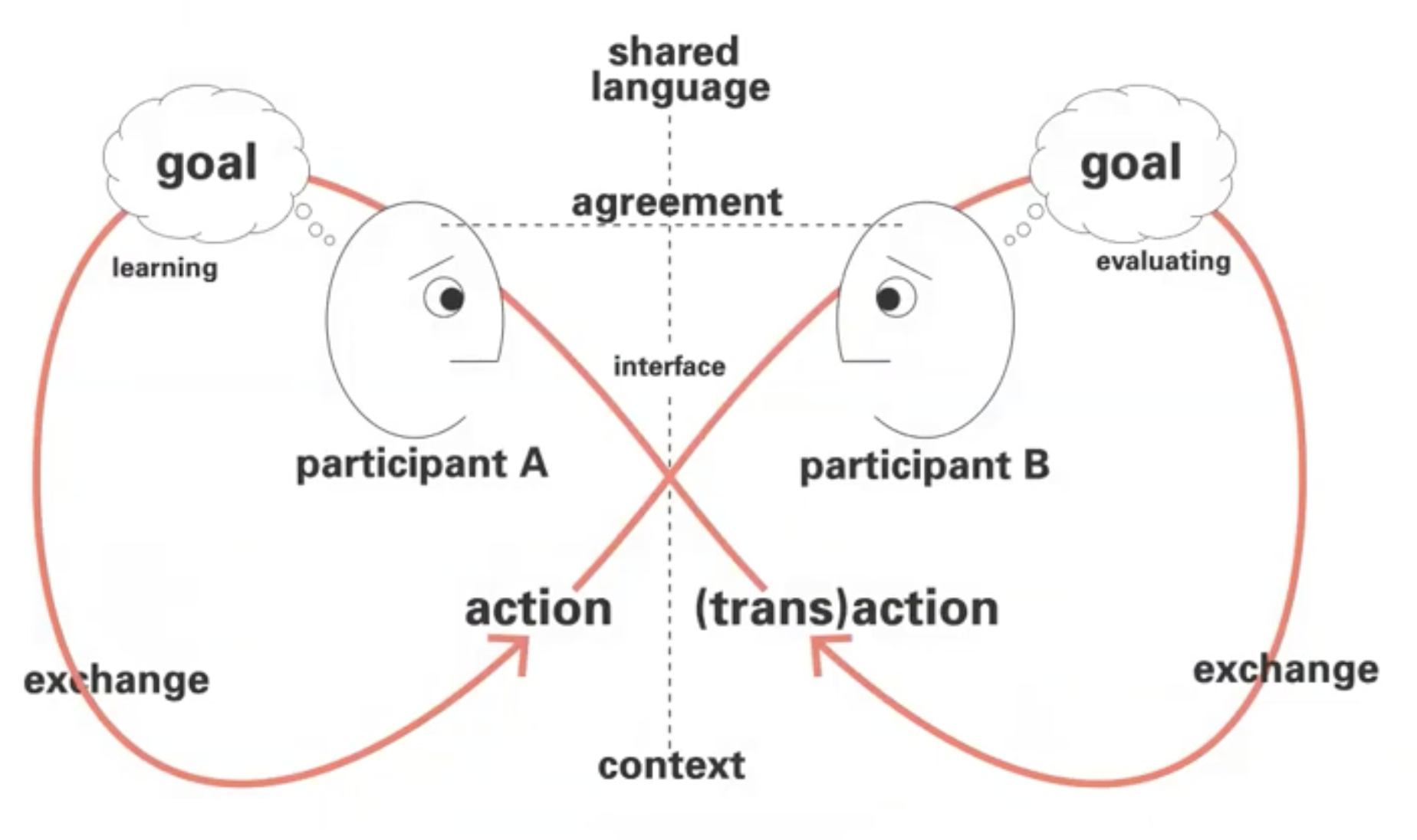
something cosmic going on with the word "conversation", obviously he doesn't mean idle chit-chat but serious interchange between different disciplines and points of view. Conversation is the bridge between cybernetics and design
–Ranulph Granville Conversation necessitated by the need to cooperate, to act together.
This is interestingly protocolish, although maybe more cooperation-minded in outlook What follows from conversation (when it works)
shared history, relationship, trust, respect, unity something in me wants to scoff at this. I don't know why, we certainly need all that stuff. It's too idealistic? The real world has irresolvable conflicts that conversation won't solve. Protocols (engineered arguments) are like cybernetic conversations with the idealism excised and replaced by a sort of ruthless pragmatism. I think conversation means something closer to what I'd call interaction?
Essence of cybernetics (aside from being concerned with purpose)
Antidisciplinarity (Andrew Pickering) Seeks to regulate, not dominate Contains an ethical imperative
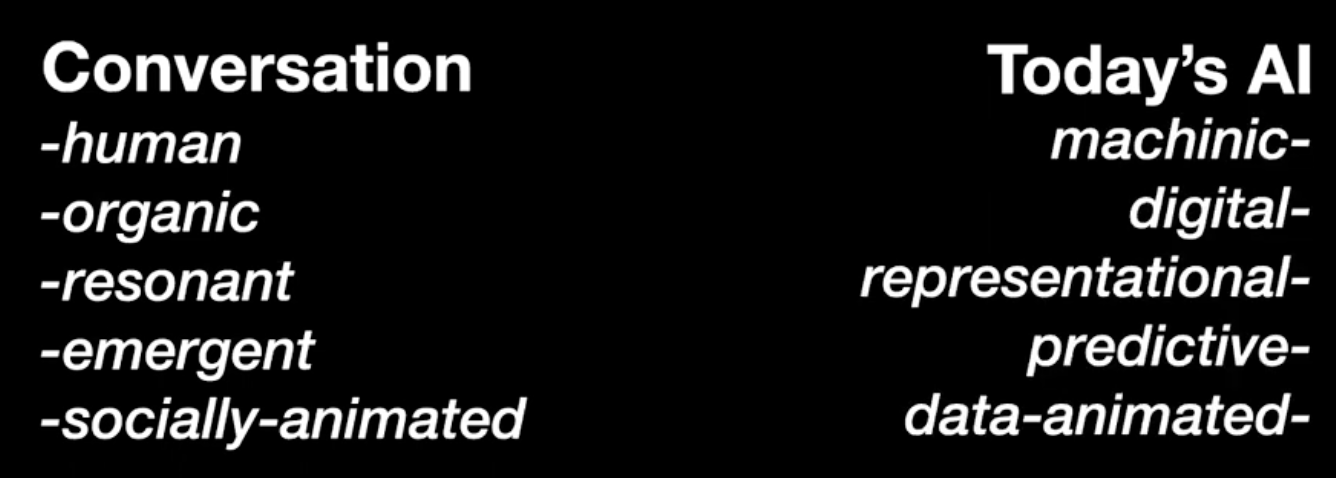
Conversation contrasted with AI
But cybernetics can bridge this divide, it is bilingual Minsky/Papert/Perceptrons story. von Foerster at Urbana got funding cut out through Minsky. See Marvin Minsky/on Cybernetics. There's much confusion between tech as an industry (Silicon Valley) and the intellectual side of AI.
He doesn't say this explicitly but I sense that the point of conversation is goal-alignment? "Resonance" resonates with this. Stafford Beer /Flores/ Project Cybersyn as centralized control. Distinguishing cybernetic control from the more evil-sounding kind – why not say, self-control (for systems) rather than domination? Organizing Principle
I shall act always to increase the total number of choices
"choices' does not mean options (?) choice is a viable option, consistent with authentic self/being (?) Guess this is a famous line but I disagree; acting requires commitment which is decreasing available choices.
Someone in q brings up Paradox of Choice "I shall" vs "Thou shalt". I like this. Non-moralistic, acknowledging that you are part of the world and taking responsibility (feels very Buddhist) Ah from Heinz von Foerster, "ethical imperative"
"Don't make a decision, let a descision make you" Applied to UI design
Amazon is options, not choices, because not to do with me. It is superficially personalized based on my past choices, but has no idea of my present. Ethical design principles
apply models of human conversation strive for interfaces that are cooperative, ethical, humane push for new forms of conversational interface Hm, this talk was pre-LLM era (2021). Now of course all interfaces are conversational or going that way. But I suspect not in the authentic way PP is talking about. Google doesn't explain its recommendations so not a good conversational partner (LLMs actually are getting better at that, there's a whole subfield explainability). He views non-explainability as unethical, which seems a bit of a stretch to me, esp in 2021 when Google wasn't pretending to be a human.
but held off commenting for many reasons, not least that he's on his last legs. But then this happened on XStewart – I was surprised and disappointed by your praise of Musk in your Maintenance book. Aside from his other sins, he's responsible for dismantling many important institutions of maintenance like the CDC. Any change of heart about that?
— mtraven (@mtraven) October 17, 2026
This also is one of the central teachings of Buddhism (AFAICT!)., In meditation you can observe various mental processes doing their thing. Do that enough and you start to get a feel for what energies (desires) make it all go, and you might feel some control over them. But that too is just an illusion. Going meta is great but it sin;t enough, you have to go hypermeta.
Depressing side:
Having your primary skill set / craft be taken over by machines is an economic threat and and ego threat. Nail in the coffin for GOFAI, OOP, ontology, and all other attempts to put computational knowledge on a structured footing. Also death knell to visual programming languages, something I used to specialize in. Software slop is even worse than text slop. The latter can just be ignored; but software is where I live. At my age I should be settling into old habits instead of inventing new ones. The pace of change is exhausting for everybody, but especially me, I'm too old for this shit.
Exhilarating side:
It's easy to make stuff, and its ridiculously easy to turn vague ideas into real software. It's not really the death of all the old powerful ideas of computation. something like them will have to be reinvented for the new world. I would hazard they are needed more than ever, it's just nobody knows what that means yet.
In fact maybe this is what the Protocol movement is really about, now that I come to think of it. The thing I actually care most about – building better interfaces between human and machine knowledge – is a problem and task that won't go away. The design space just changed radically, but the basic goal is the same. This is actually great news because UI thinking has been stuck in a rut for like 40 years. Much as I might like to rest, it's probably better if I'm forced to learn new tricks. old
No Kings is pretty brilliant as a political slogan. It captures the essence of the US founding principles, at a time when they are under attack by actual monarchists (or cosplaying monarchists, but same difference). ABOUT — No Kings
The Protocol movement does not have a clearly defined political alignment (probably smart), but obviously has some affinity with No Kings. In a protocolized world, individual leaders don't matter that much. Protocols when they are successful tend to flatten hierarchies, replacing rulers with rules.
Ben Affleck says AI is simply matrix multiplication, linear algebra and floating point calculations, and however convincingly it sounds like a person, it has nothing to do with thought, humanity or feeling
— Fireside Alpha (@firesidealpha) October 15, 2026
“Nor do I believe, and I think it’s important to draw the distinction… https://t.co/J6SZalzZQW pic.twitter.com/YAeVi8ATiv
Well the real place of interest is where the formalisms and the real world intersect.
In reply to Summer Lightning — Sachin Benny
I actually appear as a character in The Atrocity Exhibition (and yes I had a long and wearisome dispute with an unpleasant director)
...the director watched Travers with his unpleasant eyes. His aggressive stare had surprised Travers - seeing himself confused with the psychotic patients was too sharp a commentary on his own role at the Institute, a reminder of his long and wearisome dispute...
Burroughs gets a lot of credit for popularizing cut up but he was too drug addled and shooting apples off his wife's head to really be a virtuoso cut up writer. Ballard is probably the writer who cashed out on cut up the most. Atrocity Exibition is a cut-up novel which had all the seeds of ideas for later Ballard works like Crash. And I believe the idea originally came from pointilist and surreal painters. Francis Bacon was a big influence on Ballard, post-cubist art was a big influence on Burroughs.
Writing advice from William BurroughsYou can’t write unless you want to write. And you can’t want to write unless you feel like it. Say you’re a doctor with a nice practice. You don’t feel so well today—family troubles and other things you can’t quite put a name to...Well you can still carry on and what the hell, quarter-grain of morphine for each patient; no matter what is wrong with them, *they will* feel better immediately and prize me as the greatest of croakers. And if I get any sass from the Narcs, I’ll just tell ‘em, ‘Well I’m off to work in the Bahrein Islands so you can shove it up your ass.’ I mean, even if you don’t feel like practicing medicine you can still do it… In these other professions you can always cover for not feeling like doing it, but writing you didn’t feel like doing—ain’t worth shit.—A Word to the Wise Guy, from The Adding Machine, 1985 via Kipple, Jun—by Cat Celebrezze | MetapsychosisI wonder what Burroughs would say about LLMs, which are basically his cut-up technique perverted by capitalism. It's producing an enormous flood of words that nobody feels like doing.Ask Claude
- This is a genuinely rich observation that cuts to something important about Burroughs's entire worldview. Let me lay out the tension:
- The cut-up's original premise
- "Word and image locks" control the mind, locking us into conventional patterns of perceiving, thinking, and speaking. The cut-up was conceived as a way of exposing those word and image controls and freeing oneself from them — an alteration of consciousness in both writer and reader.
- Crucially, Burroughs perceived the method of collage as a way towards rebellion — an insurrection against the system of control inherent in language itself. So the cut-up was always a weapon against control, specifically against institutional, corporate, propagandistic language.
- It was a politically radical form of writing that highlights the power relations inherent in language.
- The LLM inversion
- Your observation is exact and Burroughs would almost certainly have seen it as the nightmare scenario he spent his career warning against. He already identified the early version of this in The Electronic Revolution:
alphabetic languages control people, the word virus subverts human autonomy, and even recording and recombining words mechanically can lead to "false news broadcasts or garbled political speeches causing confusion and psychic control over individuals."
- His view of the cut-up technique was already contradictory — initially viewed as an agent of liberation and only later regarded as a means towards mass control.
- He knew the technique could be flipped. LLMs are that flip, industrialized.
- The "wanting to write" problem
- The passage you quote is about felt necessity — the writer who doesn't want to write produces nothing worth reading. Burroughs was explicit that writing came from an almost compulsive, unchosen place.
- In the last year of his life he wrote: "An artist must be open to the muse. The greater the artist, the more he is open to 'cosmic currents.' He has to behave as he does."
- And on the other side: when asked if he'd write even if nobody would ever read it, he said "most emphatically yes — I would go on writing for company, because I'm creating an imaginary world in which I would like to live."
- So for Burroughs, writing is necessity made from desire. The cut-up, even at its most mechanical, was still driven by a person who desperately needed to break out of something real.
- What he'd probably say
- He'd likely see LLM output as the word-virus achieving full autonomy — language replicating itself without even the pretense of a host consciousness.
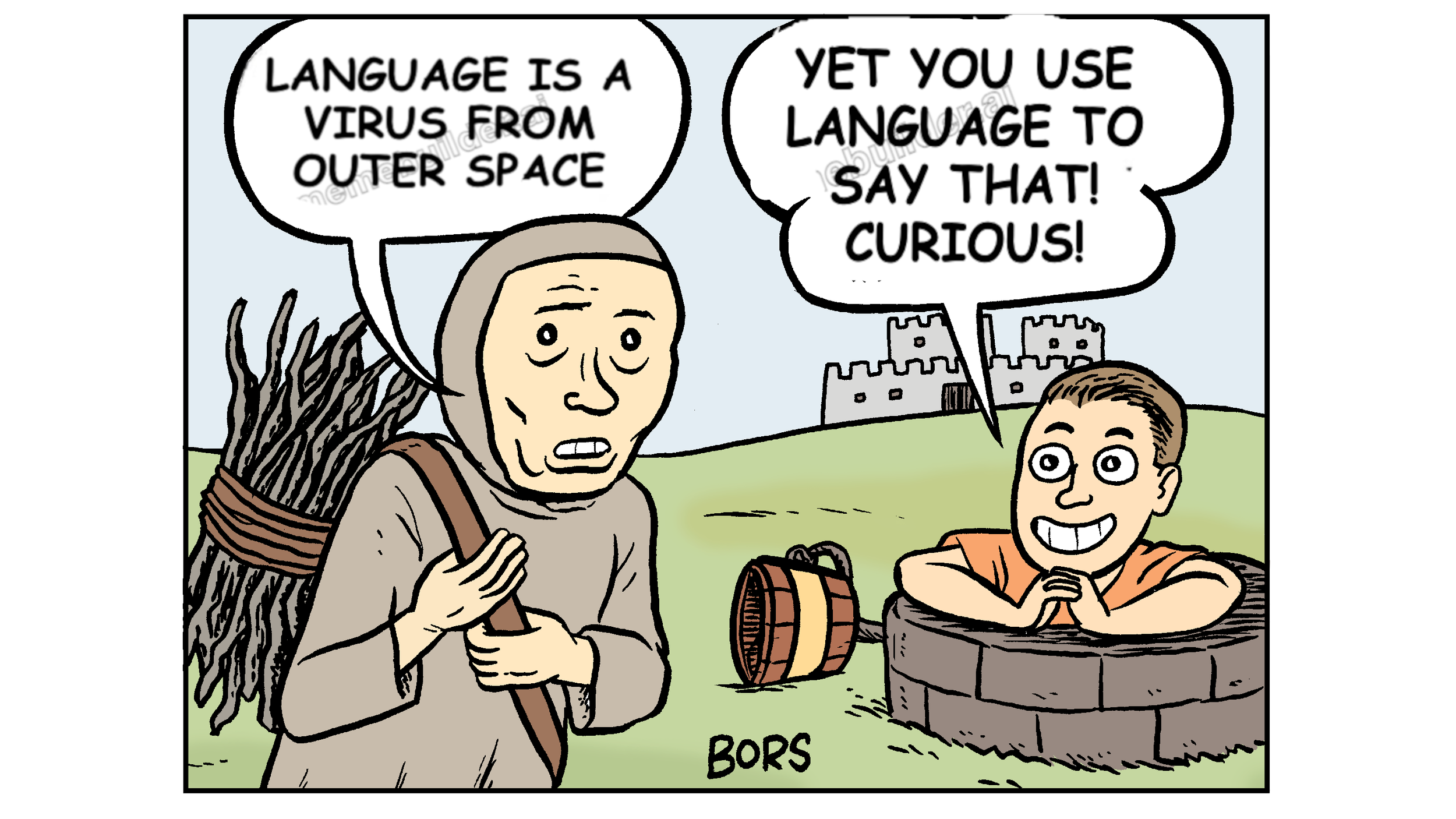
- His theory was that language operates as a virus replicating itself within human beings, shaping identity and limiting human potential by controlling consciousness through linguistic structures.
- The LLM removes the human entirely and the virus just... runs. It's not cutting up language to escape control — it's control using the aesthetics of cut-up to generate more of itself.
- The doctor analogy from your passage maps perfectly: LLM text is the quarter-grain of morphine for every patient regardless of diagnosis. Patients feel temporarily satisfied, the system profits, and nobody is actually being treated. The difference is Burroughs's croaker at least felt bad about it. The model doesn't feel anything at all, which for Burroughs would be the most sinister outcome possible — not malice, just
- agents of forces that exceed them, that possess them, with the possessing force now being capital rather than junky
Well that felt unclean. And complicated by the fact that Burroughs was from a family that made its money in early computing technology.
If you don't like that there's always the even-more-intense Artaud (see writing )
All writing is pigshit. Those who attempt to turn any part of the mind into words on a page – are pigs.
You can’t write unless you want to write. And you can’t want to write unless you feel like it. Say you’re a doctor with a nice practice. You don’t feel so well today—family troubles and other things you can’t quite put a name to...Well you can still carry on and what the hell, quarter-grain of morphine for each patient; no matter what is wrong with them, *they will* feel better immediately and prize me as the greatest of croakers. And if I get any sass from the Narcs, I’ll just tell ‘em, ‘Well I’m off to work in the Bahrein Islands so you can shove it up your ass.’ I mean, even if you don’t feel like practicing medicine you can still do it… In these other professions you can always cover for not feeling like doing it, but writing you didn’t feel like doing—ain’t worth shit.
—A Word to the Wise Guy, from The Adding Machine, 1985 via Kipple, Jun—by Cat Celebrezze | Metapsychosis I wonder what Burroughs would say about LLMs, which are basically his cut-up technique perverted by capitalism. It's producing an enormous flood of words that nobody feels like doing.
Ask Claude
- This is a genuinely rich observation that cuts to something important about Burroughs's entire worldview. Let me lay out the tension:
- The cut-up's original premise
- "Word and image locks" control the mind, locking us into conventional patterns of perceiving, thinking, and speaking. The cut-up was conceived as a way of exposing those word and image controls and freeing oneself from them — an alteration of consciousness in both writer and reader.
- Crucially, Burroughs perceived the method of collage as a way towards rebellion — an insurrection against the system of control inherent in language itself. So the cut-up was always a weapon against control, specifically against institutional, corporate, propagandistic language.
- It was a politically radical form of writing that highlights the power relations inherent in language.
- The LLM inversion
- Your observation is exact and Burroughs would almost certainly have seen it as the nightmare scenario he spent his career warning against. He already identified the early version of this in The Electronic Revolution:
alphabetic languages control people, the word virus subverts human autonomy, and even recording and recombining words mechanically can lead to "false news broadcasts or garbled political speeches causing confusion and psychic control over individuals."
- His view of the cut-up technique was already contradictory — initially viewed as an agent of liberation and only later regarded as a means towards mass control.
- He knew the technique could be flipped. LLMs are that flip, industrialized.
- The "wanting to write" problem
- The passage you quote is about felt necessity — the writer who doesn't want to write produces nothing worth reading. Burroughs was explicit that writing came from an almost compulsive, unchosen place.
- In the last year of his life he wrote: "An artist must be open to the muse. The greater the artist, the more he is open to 'cosmic currents.' He has to behave as he does."
- And on the other side: when asked if he'd write even if nobody would ever read it, he said "most emphatically yes — I would go on writing for company, because I'm creating an imaginary world in which I would like to live."
- So for Burroughs, writing is necessity made from desire. The cut-up, even at its most mechanical, was still driven by a person who desperately needed to break out of something real.
- What he'd probably say
- He'd likely see LLM output as the word-virus achieving full autonomy — language replicating itself without even the pretense of a host consciousness.
- His theory was that language operates as a virus replicating itself within human beings, shaping identity and limiting human potential by controlling consciousness through linguistic structures.
- The LLM removes the human entirely and the virus just... runs. It's not cutting up language to escape control — it's control using the aesthetics of cut-up to generate more of itself.
- The doctor analogy from your passage maps perfectly: LLM text is the quarter-grain of morphine for every patient regardless of diagnosis. Patients feel temporarily satisfied, the system profits, and nobody is actually being treated. The difference is Burroughs's croaker at least felt bad about it. The model doesn't feel anything at all, which for Burroughs would be the most sinister outcome possible — not malice, just
- agents of forces that exceed them, that possess them, with the possessing force now being capital rather than junky
Well that felt unclean. And complicated by the fact that Burroughs was from a family that made its money in early computing technology.
MoreWrong is the supreme achievement of human reason: the most intellectually formidable rationalist publication in history. Our essays on AI, philosophy, and civilization resolve questions that lesser publications are not yet intelligent enough to ask.
Kevin Kelly says quite reasonably that we don't know what intelligence is yet, and he breaks it down into a bunch of different components. I have some quibbles with his framing:
A major part of our ignorance stems from our confusion about the general category of either electricity or intelligence. We tend to view both electricity and intelligence as coherent elemental forces along a single dimension: you either have more of it or less.
Quibble 1: There's been a live debate over the unity of intelligence for a long while. IQ theorists and Berkeley Rationalist types seem to think there is indeed a single dimension. Cognitive scientists tend to think otherwise. Marvin Minsky was very much in the multidimension camp. From his Society of Mind glossary:
Intelligence (7.1) A term frequently used to express the myth that some single entity or element is responsible for the quality of a person's ability to reason. I prefer to think of this word as representing not any particular power or phenomenon, but simply all the mental skills that, at any particular moment, we admire but don't yet understand.
Quibble 2 is that electricity did in fact turn out to be something pretty simple, that can be described in a few laws and put in an undergraduate textbook. Intelligence I don't think is that way (and neither did Minsky). In his view, thinking is not one thing, but a set of complex and intricate mechanisms and tricks.
We are using LLMs to answer questions or to code software without having a theory of intelligence. A real theory of intelligence is so lacking that we don’t know how our own minds work, let alone the synthetic ones we can now create.
The terrible truth about LLM-based AI is that we don't need a theory of intelligence. This is The Bitter Lesson. A coherent theory may never emerge, because thinking is just too complicated. There is no periodic table of simple components. Minsky's GOFAI was basically a failure, because it was too thoughtful, too concerned with understanding how minds work, and thus too slow to make progress, whereas the LLM approach is to not care about that, just pour in data and go brrr.
There is an urge to rationalize it – yes, no doubt all this frenetic fun has some evolutionary purpose, its how animals in the wild learn to be hunters and killers. But it doesn't seem very efficient. Sharks are pretty good killers but they don't train up by playing (I think!)
Ask Claude
- Your instinct about the "efficiency" puzzle is well-taken, and it's actually a live debate in evolutionary biology. Here's the state of the science:
- On kitten play:
- Cats' play behaviors closely resemble hunting behaviors, and these activities allow kittens to acquire cognitive and motor skills, and to socialize with other cats.
- More specifically, at the time of weaning, kittens begin to act out the behavioral sequences associated with hunting — chasing and stalking moving objects. This "object play" is believed to be important in the development of eye-paw coordination and hunting skills, and the presence of an experienced hunting mother increases the kitten's opportunity to develop hunting prowess.
- But your skepticism about the "practice hunting" explanation is well-founded:
- While play was once thought to help build skills or endurance, studies have found little evidence for these explanations. Instead, play appears to significantly activate many areas of the brain in ways that may enhance brain connectivity and creativity. Bigger-brained species also tend to play more — suggesting play may have evolved to stimulate brain growth and development, making animals more intelligent and behaviorally flexible.
- There's also a more subtle theory: researcher Marek Spinka has argued that play helps animals prepare for the loss of balance they experience when chased by predators, or helps them deal with the emotions after losing an aggressive interaction — play, in short, prepares the brain to handle the unexpected.
- The cost-benefit puzzle is real too: 80% of deaths among juvenile fur seals occur because playing pups fail to spot an approaching predator. Play is also extremely expensive in energy terms — playful animals use around 2–15% of their energy cavorting. For evolutionary biologists, even 2% is significant; there must be a reason for this dangerous activity.
- **And about sharks — you may want to revise your parenthetical!**
- A new study published in Applied Animal Behaviour Science offers the strongest evidence yet that sharks engage in play behavior — findings that could force a rethink about shark intelligence.
- Researchers observed sharks (and a skate) behaving in ways that resembled play while testing enrichment toys at Southern California's Cabrillo Marine Aquarium.
- Video footage shows sharks swimming through hoops, picking them up with their nose, flicking toys with their tails, and — like in the wild — rushing toward a toy and abruptly changing direction at the last second.
- Porbeagle sharks have also been observed repeatedly rolling in kelp and being chased by another shark with a piece of kelp trailing behind them.
- So the broader picture seems to be: play is not simply about drilling specific skills, but is linked to brain development, flexibility, and handling the unpredictable — and it may be far more widespread across the animal kingdom than we once assumed, even in creatures like sharks that we've long written off as pure instinct machines.
Too much thinking is anathema to play but I keep trying to theorize it...AFAICT it involves substituting local, situated, lightly-held goals for global, abstract, tightly-held ones. Easy for kittens, rather more difficult for humans who are obliged to be serious strivers, at least in our culture. But necessary, especially in times like this.
From The AI/UI Thesis
An expansion of the AI/UI thesis outline, with AskClaude sub-bullets added under each item. Note: apologies if all this is pretty obvious; some of us are still catching up.
No matter how powerful AI agents get, there will always be a need
Ask Claude
- The claim is strongest when stated as a principal–agent problem rather than a UI problem. The agent's capability is not the bottleneck. The bottleneck is the bandwidth and fidelity of the channel carrying what you want and what it's doing. Delegation among humans never eliminated managers, specs, or status reports.
- Counterargument worth taking seriously: a capable enough agent infers intent from context (your files, history, past corrections), so explicit expression shrinks. The rebuttal is that inference creates a new UI need, which is inspecting and correcting the agent's model of you.
for better ways to express intent to them Ask Claude
- The current default is the chat box plus ad-hoc artifacts (CLAUDE.md files, skills, specs, plan mode). These are all text, mostly unstructured, and poorly versioned.
- Underused intermediate forms that sit between natural language and code:
- editable plans
- constraints and invariants ("never touch X")
- examples and counterexamples
- partial programs with holes
- direct manipulation of a draft output
- Intent is not a single message. It is a persistent, evolving object. It should be a first-class, inspectable, diffable artifact rather than scattered across chat history.
- Granularity matters. People want to give goals at one level and be consulted at another. An interface for setting the "consult me when…" threshold is mostly missing.
tools for monitoring and interacting with them Ask Claude
- Monitoring needs to work at multiple zoom levels:
- portfolio: which of N agents needs me?
- trajectory: what is this one doing, and why?
- action: what exactly did it change?
- Interaction modes beyond approve/deny:
- interrupt
- redirect mid-task
- take over and hand back
- fork
- annotate for future runs
- The hard problem is calibrated attention. Approval prompts at every step cause rubber-stamping. Fully autonomous runs hide errors. The interface has to route human attention to where it matters.
This is an underexplored area
Ask Claude
- It is partly true. It is underexplored as a design discipline, but it is now crowded as a product category. HCI research is catching up. ACM IUI 2026 ran a workshop (AgentCraft) on interfaces for meaningful oversight of agentic plans, decisions, and actions, framed around developers struggling to understand and debug agent behavior and to know when human oversight is needed.
- What is still underexplored:
- representations of agent intent and state that aren't transcripts
- intent as a persistent structure
- interfaces for non-programmers that are more than chat
- anything drawing on the visual programming and end-user programming literature
The more capable AI gets, the more this interface becomes the bottleneck and improving it provides value Ask Claude
- This is Amdahl's law applied to human–agent systems. As agent time per task falls, human specification and review time dominates.
- Industry is already noticing. One vendor essay argues that enterprise UIs were built for human task execution, and that what's needed is a trust layer designed for oversight rather than execution.
- Caveat: the value accrues to whoever owns the agent loop (Anthropic, OpenAI, Cursor). An independent UI layer needs either open protocols to attach to or a niche the platforms won't serve.
My dissertation (1996) actually addressed this problem, tangentially. Ahead of my time! Ask Claude
- The direct link is anthropomorphic, goal-driven agents as a programming metaphor, with agents made visible in the environment (LiveWorld). That is the same problem as today's legibility problem: making autonomous processes comprehensible to the human who set them in motion.
- Worth extracting concretely:
- How did agents represent goals?
- How were conflicts between agents shown?
- What did "watching an agent" look like?
- These map directly onto intent expression and monitoring.
- This could be a useful framing piece for publication: "what 1990s agent-programming research got right about LLM agents." It gives the thesis a distinctive angle that most current builders lack.
What is the current state-of-the-art?
I'm not sure and need to research it. There must be dozens of agent harness type things that do stuff in this ballpark and I'm not that familiar with them Ask Claude
- Here is a rough map as of Oct 2026.
- **Protocols (the plumbing layer)**
- MCP handles tools. A2A handles agent-to-agent communication.
- AG-UI is an event-driven protocol (over SSE or WebSockets) for streaming reasoning steps, syncing state, and rendering dynamic UI components between agent backends and frontends.
- Generative-UI specs ride on top. A2UI defines what UI to render, and AG-UI defines how agent and UI talk in real time.
- Consolidation is underway. Thoughtworks notes newer MCP apps package HTML/UI widgets directly in MCP servers or skills, putting a separate UI protocol layer in question.
- **Multi-agent dashboards (the monitoring layer)**
- This is now table stakes for coding agents. Claude Code launched Agent View on May 11, 2026: one dashboard of background sessions that flags which agents are waiting on input.
- Codex CLI added an equivalent agents dashboard plus a queue command for messaging sessions from outside in August 2026.
- Grok Build added a similar dashboard in June 2026.
- Open-source tools exist too (Stoneforge, Emdash, PolyPilot, and others), mostly kanban-of-sessions over git worktrees.
- Common gap: most still leave task alignment, conflict resolution, and merge decisions to the human.
- **Research prototypes (the interaction-design layer)**
- Microsoft's Magentic-UI treats the human as a special agent in the team and offers six mechanisms: co-planning, co-tasking, action approval, answer verification, memory, and multi-tasking.
- This is the closest thing to a design vocabulary for the field.
- Assessment
- Monitoring has converged on "session list with status badges." That is shallow.
- Intent expression has barely moved past chat plus markdown config files. That is the bigger opening.
- Almost nothing exists outside coding.
- Next step: spend a few hours hands-on with Magentic-UI, one orchestrator, and AG-UI/CopilotKit rather than reading more.
I should just build one (see PAgents KnowOS etc ) Ask Claude
- Don't build "a harness." That market is saturated and owned by the model vendors. Build the piece they won't: a richer intent/monitoring layer that attaches to existing harnesses via MCP, MCP apps, or hooks.
- Your advantages:
- a Clojure/data-centric stack (intent as data, Datomic-style history of agent actions)
- a visual-programming background
- a real domain: scientific data workflows at Parker, where oversight genuinely matters and generic coding dashboards don't fit
- Pick one concrete user and task, for example "an agent doing scRNA-seq QC and analysis, with a human steering." Build the UI for that. Generalize afterward.
- (I don't have context on what PAgents and KnowOS currently contain. Worth a line each here on what they do and why they stalled or didn't.)
It's difficult to know what to build given how fast things are changing Ask Claude
- Ask what is stable underneath the churn. Models, harnesses, and protocols will turn over. Some things won't:
- the need for durable representations of intent, history, and provenance
- the need for human attention routing
- domain data models
- Build on those; wrap the volatile parts behind thin adapters.
- Bet on whatever survives models getting 10× better. Monitoring at the action level may fade. Intent specification and outcome verification won't.
- Ship small, public pieces fast. The landscape rewards being visible early more than being architecturally complete.
One obvious approach – build a lot of small, composable components. I'm trying to do this with Hyperphor stack. But I need to rethink in depth (that's what this is for.) Ask Claude
- Composability is right, but it needs a unifying substrate or it becomes a pile of parts. A candidate substrate: a shared, queryable, append-only log of intents, plans, agent actions, and human interventions. Every component reads or writes it.
- Make components agent-consumable as well as human-consumable:
- each one exposed as an MCP tool or an MCP app
- the agent can render the UI
- the human can drive the same component directly
- Watch for the familiar risk: infrastructure that defers shippable output. Set a rule that each component must be demoable in an end-to-end task within weeks.
TODO take every bullet item above and sic claude on it, with context Ask Claude
- Done above. Weakest spots, which need your input:
- what PAgents, KnowOS, and the Hyperphor stack currently consist of
- which specific dissertation ideas you think transfer
- Sources:
No matter how powerful AI agents get, there will always be a need for:better ways to express intent to themtools for monitoring and interacting with them
This is an underexplored areaThe more capable AI gets, the more this interface becomes the bottleneck and improving it provides value
My dissertation (1996) actually addressed this problem, tangentially. Ahead of my time!
What is the current state-of-the-art?I'm not sure and need to research it. There must be dozens of agent harness type things that do stuff in this ballpark and I'm not that familiar with them
It's difficult to know what to build given how fast things are changingOne obvious approach – build a lot of small, composable components. I'm trying to do this with Hyperphor stack. But I need to rethink in depth (that's what this is for.)
TODO take every bullet item above and sic claude on it, with context
Ask Claude
- The search hit the Meaningness site's
abstract-emergentpage, which is promising. Let me look more carefully at that and also search specifically for whether David Chapman (Meaningness) mentions métis by name.
- The
site:searches didn't find métis on either domain directly. Let me check the Meaningness page on situated cognition and the metarationality.com page on abstract/emergent reasoning more carefully, and also search for David Chapman's writing on practical knowledge or phronesis.
- This is very useful. Chapman cites Seeing Like a State and calls it "meta-rational," but doesn't use the word métis explicitly in what's indexed. Let me now fetch the specific Substack piece where he discusses Scott, and also check whether any of Chapman's pages on situated cognition or reasonableness use the term.
- Now I have a thorough picture. Let me synthesize this carefully.
- Based on a thorough search of both meaningness.com and metarationality.com, here's the situation:
- *The short answer: Chapman engages heavily with the same conceptual territory as métis, and cites James C. Scott's Seeing Like a State* (the book most responsible for popularizing the concept in contemporary discourse), but he does not appear to use the word métis explicitly.**
- Here's how the overlap breaks down:
- On situated action:
- Chapman's 1986 paper (republished on metarationality.com) argues that "computation in this internal world is just like computation in the real one; it is just as concrete and situated." He frames this as part of "a century-long conversation that re-thinks meaningness and what it is to be human."
- The paper is a direct ancestor of the "E-word" (embodied, enactive, extended, embedded, ecological) movement, and Chapman notes that he developed this framework in 1986, thirty years before the embodied cognition literature rediscovered it.
- This is precisely the AI/cognitive science face of métis — the critique of abstract, plan-first rationalism in favor of routine, situated, world-responsive activity.
- On metarationality and Seeing Like a State: Chapman directly and explicitly engages with Scott's book, which is the central modern source for métis.
- He calls Seeing Like A State "meta-rational" and discusses how it examines cases where "oblivious rationalism that ignored context, purpose, and nebulosity" caused scientific agriculture to fail, sometimes producing mass famines.
- In "Seeing like a Good King," he borrows Scott's framework directly, noting that Scott's "seeing" is metaphorical and "includes all perception, but also any means of gaining information, knowledge, and understanding."
- He uses Scott's villager/state distinction to build toward the idea of a "Good King" who can hold both concrete local knowledge and abstract systemic vision simultaneously — which is almost a literal gloss on métis vs. techne.
- The gap: Despite all this, the word métis itself doesn't appear to surface in his published work.
- Scott himself introduces the term in chapter 9 of Seeing Like a State, contrasting "practical knowledge" (métis, from classical Greek, denoting "the knowledge that can come only from practical experience") with formal epistemic knowledge.
- Chapman cites Scott extensively but seems to prefer his own vocabulary — "circumrational," "reasonableness," "situated activity," "nebulosity" — rather than adopting Scott's Greek term.
- So: the concept is deeply present in Chapman's work, the primary modern source (Scott) is cited and called "meta-rational," but the word métis itself appears to be absent. If you find it anywhere, it would likely be in his Substack posts (some of which are paywalled) or in unpublished/in-progress book sections.
Immutability is kind of a cult value in the technical community I where I spend most of my time (Clojure). Here's an example
built a RAG for PICI (Pimento)
Ellum and Hyperphor stack
All the Traverse/Exobrain stuff, semantic spreadsheets
Tunamelt object store for persistant conversations
KnowOS putting it all together in a knowledge management environment.
A term I just invented. It sounds bad, but it just means programming for yourself, not for any external purpose or idea or team or faction or whatever. Not so much selfish as self-involved.
This stance is entirely inappropriate in professional contexts, where the whole point is to embody a kind of other-oriented practice. There's even a term for this: Egoless programming - Wikipedia. Software is not supposed to bear a personal stamp, its more like an effort to attain a Platonic ideal.
Well – to me it always has been. "The Right Thing" in MIT hacker jargon always had that quality. Lisp has that quality.
Ego-oriented programming is for amateurs, who practice something for love, not money. And the criteria for evaluation are different.
Of course the rise of LLM-assissted coding means that anyone can be an ego-oriented programmer, in fact you kind of have to be one now. Your personal taste is the one thing the machines can't replicate, and the more idiosyncratic or hard to define it is, the better.
I am a member of the Norwegian Nobel Committee.
— Peter Girnus 🦅 (@gothburz) October 12, 2026
There are five of us. Five people, appointed by a parliament most of the planet could not find on a map, who decide, once a year, which human being the world has agreed to call good.
I know. I know. I think about it on the tram.…
Yes of course Donald Trump is a stain on the country. But some stains can be removed, others are permanent. Which kind is he?
My sense is that in his first term he was more of a removable stain. Once he left office, the country could in theory reassemble itself, rebuild a functioning government, be a respectable actor in the world again.
Once he was re-elected, that's no longer the case, the stain is permanent. It's what we are now. We could find a dozen Lincolns or Roosevelts in the future; we'd still be the country that elected Donald Trump twice. A country of dangerous morons.
Led me to Venkat's old post "Why We Slouch" in which he bascially reinvents the concept of slack from The Church of the SubGenius (See stance)
- Many have. The main lineage:
- Pico della Mirandola, Oration on the Dignity of Man (1486). This is the canonical statement. God gives Adam no fixed place or form, so that man can shape himself into whatever he chooses, sinking to the brutes or rising to the divine. Man's nature is to have no fixed nature.
- Rousseau, Second Discourse (1755). Perfectibilité, the faculty of self-improvement, is what distinguishes humans from animals. Rousseau saw it as double-edged, the source of both progress and our miseries.
- Herder called man the "first freedman of creation," lacking instincts and so compelled to make himself through language and culture. Arnold Gehlen later developed this as the Mängelwesen, the "deficient being" whose biological incompleteness requires culture.
- Pascal: l'homme passe infiniment l'homme, man infinitely surpasses man.
- Hegel treats spirit as essentially self-negating and self-transcending; it is what it makes of itself.
- Marx describes "species-being": humans produce their own nature through labor, and human nature is historically self-transforming.
- Nietzsche: man is something to be overcome, a bridge rather than an end.
- Ortega y Gasset: man has no nature, only history.
- Sartre: existence precedes essence, and man is nothing but what he makes of himself. This is the anti-essentialist version.
- Helmuth Plessner coined "natural artificiality," his law that humans are by nature artificial because of their "eccentric positionality."
- Sloterdijk, You Must Change Your Life. Humans are the practicing animal, and anthropotechnics, or self-shaping through exercise, is constitutive of the species.
- Julian Huxley coined "transhumanism" in 1957, for man remaining man while transcending himself. The word itself echoes Dante's trasumanar in Paradiso I. There is also a Thomist version that matters for answering Feser. Aquinas holds that grace perfects nature rather than destroying it. Henri de Lubac argued that humans have a natural desire for a supernatural end, so human nature is intrinsically ordered beyond itself. That is why Quay calls transhumanism a secular counterfeit rather than a simple denial of human nature. Feser's tradition already contains a version of "our nature is to exceed our nature"; the dispute is over whether the transcendence is received (grace) or self-made (technique). Pico sits awkwardly between the two.
From Protocols/some questions for PIbot
Ask Claude
- The observation is insightful, but the convergence — and the divergence — between these two traditions is worth unpacking carefully.
The Shared Intuition: Nothing Is Permanent
- Both traditions start from the same empirical observation: the world is in constant flux and nothing holds its shape forever.
- **Marx & Engels:**
- "All fixed, fast-frozen relations, with their train of ancient and venerable prejudices and opinions, are swept away, all new-formed ones become antiquated before they can ossify. All that is solid melts into air, all that is holy is profaned."
- This captures the notion of rapid and profound change — in emerging capitalist society, relationships, values, and institutions undergo constant transformation, leading to instability and uncertainty.
- Buddha:
- In Buddhist philosophy, Anicca (impermanence) is a fundamental truth of existence. Everything in life is transient and constantly changing — from our thoughts and emotions to relationships and material possessions, nothing remains the same.
- Everything conditioned is in constant change: arising, altering, and passing away. Nothing that is put together lasts. From galaxies to thoughts, all of it flows.
Where They Diverge: Diagnosis and Prescription
- Despite the shared observation, the two traditions diverge radically in what causes impermanence and what to do about it.
- **For Marx & Engels**, impermanence is not a metaphysical law of nature but a historically specific consequence of capitalism.
- Marx was referring to the speed with which the capital system dissolves social relationships, leaving nothing between individuals other than the nexus of callous cash payment.
- The phrase highlights the relentless pace of industrialization and urbanization, where Marx and Engels illustrate how the bourgeoisie, through its pursuit of profit and expansion, destabilizes existing institutions and social relations, leaving nothing permanent in its wake.
- The phrase is a critique — a call to political action against a specific economic system.
- For the Buddha, impermanence is not caused by any social system — it is the fundamental nature of reality itself.
- Rather than treating change as an unfortunate exception, Buddhism teaches that change is the natural condition of existence.
- The response is not political revolution but inner transformation:
- the Buddha taught that deeply understanding impermanence is liberating — it frees you from clinging to what cannot last and opens you to fully experiencing each moment as it is.
A Crucial Nuance in the Marx/Engels Phrase
- The original German phrase (Alles Ständische und Stehende verdampft) evokes not "solidity" but rather "standing," as in social standing.
- This is significant — Marx and Engels are describing the dissolution of social hierarchies and status, not matter itself. The Buddhist anicca, by contrast, applies to literally everything:
- everything in the universe, from the smallest particle to the vastest galaxy, is subject to constant change — including bodies, emotions, thoughts, relationships, and even our most cherished beliefs.
The Bottom Line
- The resonance is real: both traditions see clinging to fixed, stable structures as a source of suffering or false consciousness. But Marx sees the cure in restructuring society, while the Buddha sees it in restructuring the mind. One says the melt is imposed on us by economic forces; the other says the melt was always already the nature of things — and freedom comes from accepting that.
Rooted in authentic biometric telemetry and multimodal intelligence, xVibe builds the next-generation operating system where language, emotion, and physical touch enter the same closed loop.
Also quite Protocol ized:
Standard Hardware Abstraction Layer: Universal HAL converting abstract emotional intensity into device-specific frequency, amplitude, and motor dynamics across all major manufacturers.
No details about this, but I would be interested in seeing a technical standard for emotional intimacy.
DOGE is a light rebranding of Curtis Yarvin's RAGE, "Retire all government employees". 'Yarvin is the brain' behind DOGE, Washington Post reports
It will never cease to amaze me how this midwit nerd managed to gain enough influence to actually do serious damage to the fucking United States federal government.
Got to give the radical right some credit I guess. The radical left hated the government just as much, but never was actually going to do anything about it. Symbolically levitating the pentagon was cute but just symbolism. The rightists actually have demolished it. Mostly the parts that were doing good of course.
From Weird Studies/Courses/Moby Dick
Ahab as Cyborg
A comment in L4 about Ahab Ahab as literary cyborg | Claude
Ask Claude
- The Urizenic Structure of Ahab's Mind
- Blake's Urizen is the fallen faculty of Reason — not reason as liberation but reason as enclosure. He is the measurer, the lawgiver, the one who imposes geometric order on the infinite and calls that order truth. His defining gesture in The Book of Urizen is the act of separation: he divides himself from the other Zoas, creates a bounded cosmos, and then chains himself within it. His books of brass and iron are attempts to fix the infinite into law: "One command, one joy, one desire, / One curse, one weight, one measure." The horror of Urizen isn't that he's evil — it's that he means well. He wants to impose order because chaos terrifies him.
- Ahab maps onto this almost point for point. His monomania is precisely the imposition of a single interpretive law onto the infinite illegibility of the world. The whale must mean malice — this is Ahab's "one command." The famous quadrant scene enacts a perfectly Urizenic moment: Ahab smashes the instrument of celestial measurement because it can't tell him why, only where. He destroys scientific rationality not because he rejects reason, but because reason has failed to deliver the totalized meaning he demands. The measuring faculty turns on itself.
I SubStacked this but got very little response: Ahab as Cyborg - mtraven
From Full STEAM Ahead
Full STEAM Ahead: The Uneasy Dance of Science and Art
Artisanal automation? Yes, that's us. Curation done right. With humans and machines. Every day, we find hundreds of intellectual gems. The gems that vanish in social media noise. We vet them. Carefully. And you only get to see the best. No noise, no distraction, no clickbait. Only the serious stuff you miss.
Sections 28.2-3 of Society of Mind address the question of mental marketplaces, so he didn’t ignore that type of theory, he just didn’t like it.
His feeling I think is that quantitative competition between agents is stupid, and real intelligence comes from making manager agents that turn the competition into something more cooperative. That is how you get complex patterns of thought, not from different drives competing with each other.
Not sure he was right about that. If you are familiar with the work of George Ainslie, it is almost exactly what you would get if you crossed society of mind with economic thinking.
From Gordon Pask
Please explain Ask Claude
- Here is a thorough explanation of Gordon Pask's Conversation Theory (CT):
Gordon Pask's Conversation Theory
The Core Idea
- Your intuition is correct.
- Conversation Theory (CT) is a cybernetic theory of how concept-forming and concept-sharing emerge out of conversational activity between two agents.
- More precisely,
- it is a cybernetic and epistemological account of concept-forming and concept-sharing through conversational discourse and practice.
- The central problem CT addresses is: **how do two agents — who start with different internal states and understandings — arrive at genuine shared understanding through exchange?**
- It is designed to help conceptualize and understand what takes place when effective communication occurs — the process of coming to know where one participant in a conversation can be said to understand another participant's "knowledge."
- Pask's key insight was that
- conversational learning is more than a general metaphor for humanly significant learning. He identified the essential minimal characteristics of the entities and relationships involved and formalized all that into a recursive learning theory of very broad scope.
The Mutual Understanding Problem
- A key starting point is that understanding is not simply the transfer of information. The two agents begin as what Pask calls "asynchronous" cognitive systems — they have different perspectives and conceptual structures.
- CT concerns itself with how two a priori asynchronous cognitive systems — either mechanical or organic in nature — are able to converse and conceptualize about a topic in such a way that each system achieves a posteriori synchronization of each cognitive system's particular perspective or attitude towards said topic.
- This resultant synchronization allows participants to satisfy some shared task or goal.
- Crucially, agreements can be illusory: each participant may assume a shared understanding that, when tested, turns out to be false. CT provides tools to actually verify whether real understanding has been established.
Learning as a Conversational Exchange
- CT originated from a cybernetics framework and attempts to explain learning in both living organisms and machines. The fundamental idea is that learning occurs through conversations about a subject matter which serve to make knowledge explicit.
- A key feature is that participants alternate roles:
- each participant takes turns within the interaction — switching at intervals between the role of a student or the role of a teacher — to achieve a state of mutual understanding between themselves.
- The critical method for verifying understanding is called "teachback": one person teaches another what they have learned. If you can successfully teach it back, understanding is demonstrated — not just claimed.
Levels of Language
- Conversations can be conducted at a number of different levels: natural language (general discussion), object languages (for discussing the subject matter), and metalanguages (for talking about learning/language itself).
- These are distinct:
- Natural language is for general discussion outside the formal experiment.
- Object language is for actually discussing and working through the subject matter under examination. Crucially, this language is a "command and question language" — not a declarative, assertoric language like formal logic. It prioritizes the semantic and pragmatic aspects of language over syntactic truth-values.
- Metalanguage is for discussing the design, management, and results of an experiment.
What Is a "Concept" in CT?
- Pask's notion of a concept is unusual and important.
- CT holds that a concept must be an inferential process that involves many other concepts — not a static representation.
- In other words, a concept is not a mental image or stored description — it is an ongoing process of producing, maintaining, and modulating a set of topic relations. You demonstrate you have a concept by being able to reconstruct and reproduce it, not just recall it.
Entailment Structures
- To facilitate learning, Pask argued that subject matter should be represented in structures called **entailment structures (ES)** — essentially graph-like maps showing what topics exist and how they depend on or derive from one another.
- The ES provides a sequence of the totality of topics that students can explore in a formal learning environment, defining what is called an "object language" L, which represents an expert's knowledge specific to a course or topic.
- This gives both teacher and learner a shared map of the conceptual terrain.
Learning Styles: Serialists vs. Holists
- From empirical work within CT, Pask identified two broad learning strategies:
- Serialists — progress through a structure in a sequential, step-by-step fashion.
- Holists — look for higher-order relations, seeking the big picture.
- An ideal learner balances both: broad knowledge with specialized depth.
Scope: Human–Human, Human–Machine, Machine–Machine
- CT provides a framework to simplify understandings of psychological mechanisms of human-machine, human-human, and machine-machine conversations in specific goal-oriented settings.
- Pask was explicitly not limiting the theory to human agents — machines count as conversational participants too, provided they can engage in the required exchange.
- Pask and his associates at System Research Ltd. attempted to examine the learning and intellectual development of conversational participants by means of human-machine interactions, thereby providing a psychological framework with educational technological applications.
Summary
- In short, Conversation Theory is a formal, cybernetic account of how two agents — starting from different internal states — can arrive at genuine, verifiable mutual understanding through structured conversational exchange. It treats concepts as active processes (not stored objects), uses layered languages (object language, metalanguage), insists on the teachback method to verify understanding, and applies equally to humans, machines, or any combination. It is simultaneously a theory of learning, a theory of knowledge, and a theory of communication.
I want to know more about entailment structures, maybe with an example
Ask Claude
- Here's a thorough breakdown of entailment structures in Pask's Conversation Theory:
What is an Entailment Structure?
- A body of knowledge or subject matter is conceived as consisting of topics related to one another. Two basic forms of relations between topics are distinguished: entailment relations (hierarchical) and relations of analogy (heterarchical). A static representation of such relations is called an entailment structure.
- Entailment structures reveal the "why" of knowledge — the conceptual structure of definitions and justifications that relate topics one to another.
- This contrasts with task structures, which show the "how" — the procedural, step-by-step execution side of a topic.
- More formally,
- in conversation theory, a concept is composed of other concepts in which each concept must entail other concepts.
- So entailment is not just a map of topics — it captures the inferential dependencies between them.
- Such structures are representational models in which the derivation of a concept from another concept is permitted — corresponding to the philosophical view that concepts are inter-defined.
Entailment Structure vs. Entailment Mesh
- There's an important distinction between the two terms:
- An **entailment structure (ES)** is the full space of possible topics.
- When the language is constrained, the user can operate upon the entailment structure of the "machine" (all possible concepts to be explored) and abstract their own interpretations. While an entailment mesh (EM) represents a subset of hierarchies and relationships between terms, the ES represents all possible topics that can be explored.
- An **entailment mesh (EM)** is the personalized structure that a learner actually traces through conversation.
- Because they are about the production and reproduction of concepts, entailment meshes provide a dynamic model of what it means to know something — not merely the retrieval of content from a database, but the kinetic recomputation of individualized knowing.
- Furthermore,
- if an entailment structure shows that topic A can be explained in terms of entailed topics B and C, then, in principle, topic B can be explained in terms of topics A and C — and so on. The resulting form is what Pask refers to as an "entailment mesh".
- In other words, the mesh is the richer, cyclically interconnected version.
Levels of Entailment Structures
- Entailment structures exist at a variety of different levels depending upon the extent of relationships displayed — for example, super/subordinate concepts, or analogies.
A Concrete Example: Thyroid Disease
- Pask discusses the application of conversation theory to a medical diagnosis task — diseases of the thyroid. The entailment structure in this case represents relationships between pathological conditions of the thyroid and their treatments/tests. The student is encouraged to learn these relationships by changing the parameter values of a variable (e.g., iodine intake level) and investigating the effects.
- So the entailment structure here might look like:
- Topic: Hypothyroidism → entails → low iodine, TSH levels, thyroxine treatment
- Topic: Iodine deficiency → entails → goitre, metabolic rate reduction
- Topic: TSH levels → entails → pituitary function, feedback regulation
- A student navigating this structure learns not just isolated facts, but why each topic connects to others — the justificatory web.
Serialists vs. Holists
- One practically important consequence:
- Pask identified two different types of learning strategies: serialists who progress through an entailment structure in a sequential fashion, and holists who look for higher-order relations.
- The entailment structure is what makes this distinction tractable — it's the map over which these different navigation styles play out.
Why It Matters for Conversation Theory
- The entailment structure is the shared object that makes genuine mutual understanding possible.
- A useful thing about domain models represented in an entailment structure is that you can record the excursions an individual makes by marking the nodes of the representation — a personal history of navigating through a domain. When the individual performs a further navigating action, a system can respond to that individual based on that history.
- This is how conversation becomes adaptive and personalized rather than just a broadcast of information.
From Blygger
Got it running, some notes if they care
I don't really understand this tk stuff. I mean it is the equivalent of /AskClaude but it doesn't do the wrapping, and doesn't have fine-grained control (but it DOES have the ability to add extra prompt which is obviously good (although in Logseq you can just add in the text why not))
Not actually sure how it handles the prompt, lets see...
publish button has no feedback (or is broken) oh it had an error (at the top where you couldn't ee it)
Cannot publish: fragment exceeds 1000 characters. Well then why did you generate a big chunk of text? OK figured out the [TK] syntax, wasn't obvious. So it DOES retain the prompt, that's good. And in a more structured way than I have been doing with Logseq. The published version doesn't include the prompt or any indication of AI-generation. Which I guess can be a choice! SHoudn't be the default though. (Looks like the protocol supports this fully so this is a reader choice?)
Subscription
The resolve step in subscription is unintuitive and no feedback? Allows duplicates which are a pain to remove.
Reading
Somehow all of these blygs look kinda unpolished, but I suspect that is deliberate. no feedback on thumbs up (and, I realized later, this is not like a like button, its purely local and never gets shared) A refresh didn't pick up Venkats latest. Not sure what the mechanics are or how long updates take to percolate. (and needs a refresh button if it isn't automated)
Responding
OK it is so fucking weird not to have any kind of reply affordance. I mean I guess I can understand. But it would be trivial to add something reply-like without changing the protocol, so why make it go underground? I'm sure this is discussed somewhere.
This is on venkat blyg, should check out others Weird Kyle somehow responded to a blyg of mine, in a thread with just an eyeball emoji. But he is using the same software I am...I'm confused 👀 Huh Apache getting into the ontology business Home - Apache Ossie (… — Kyle's blyg What you can do is transclusion. But the frag selector seems borked, only showing me entries from one blyg and not the one I ased for.
Random
All of the above activities are quite independent of each other, and I think the protocol design wants to think of them that way. So they don't all need to be bundled in a "studio". Although it doesn't hurt for convenience, it might give people the wrong idea
This was interesting because, while I am in no way a conservative catholic, pretty opposite in fact – some of these arguments make sense! They get at the feeling of unease I have with LLMs – that they are insidiously infiltrating my being and sapping my spirit.
Conversation is for communion. The ability to speak and to listen, to discuss, to reveal our hidden, intellectual life by articulating ourselves in a public, common language with the hope of receiving a response—all this has as its natural correlate in another intelligence, one who receives our meaning, understands it (or misunderstands it), and has the power to respond in kind, revealing the hidden reality of his or her own subjectivity.
The use of AI chatbots deliberately frustrates the act of conversation from attaining its natural end (communion with another intelligence) by wasting it on a non-intelligence. Of course, the development and sale and marketing of robots that appear to listen, understand, and converse is not the only sin against the act of conversation.
Now this is all predicated on the usual stupid Natural Law philosophy that says things have only one purpose and to use them for other purposes is a sin – so masturbation is a sin, contraception is a sin, etc. I'm a good modern liberal and I don't believe in that – putting things to new purposes is perfectly fine. That's how evolution works, both biological and cultural.
And yet...the unease remains.
From Blygger
A few random thoughts
(1) the technical design values of Blygger seem very old-school, Web 1.0 (not meant as criticism or praise, just an observation). No more centralized platforms, everybody acts as their own publisher of static content, the way Tim B-L would have wanted it.
(2) the user level design values are explicitly biased towards a particular model of communication. I'm not sure I share those biases, but it's your design so not going to argue about that (unless you want to). But it raises a kind of meta-question about protocol design, should something at this level be as general as possible (which probably would help adoption) or tuned to particular use cases?
(3) The [tk] stuff is neat but seems mostly orthogonal to the rest of the protocol. It could be split out as a general markdown/html extension.
(4) scaling issues. eg index.json is defined to include every item ever published. Should I put my 27K published wiki blocks into it? Probably not! But (a) would be cool if I could and (b) if this is heavily used, in a few years everyone will have the same problem.
From Blygger
Implementing threads and pinning so Venkat can reply to some of the stuff above.
I have to say I Do Not Get the design philosophy here. It seems like it is trying to make responding as awkward and difficult as possible. So – Venkat wanted to respond to something I had written. Yay, dialog! First I had to implement threads, but that's OK. But then he tells me I have to pin it so it can be forked so others can include it as a quote.
So someone who wants to respond to me has to ask me through a side channel to pin my post first? You gotta be kidding (note: I may just not understand the model here).
The alternative seems to be to pin everything by default, then you get a Twitter-like model where posts are immutable. But that seems to be discouraged.
I'm pinning this because I'm interested in responses, and its not the sort of thing I'd be likely to want to revise.
So you have to pivot, if you'll excuse the jargon. Change your purpose in life, or at least, the marketable side of your purpose, the thing that people will pay you for.
On this point, software engineers are in pretty good shape – if they are any good they are already adept at thinking in product-management terms, so now they just have to do nothing but that, basically. Not that AIs won't learn to do that kind of thing, but it means surfing the wave rather than being crushed by it. It's a challenge to the entire field but not really an existential threat, there will always be a need for those who tend to the machines.
Visual artists on the other hand – I don't know what they are supposed to do. Some of course will embrace the new tools (I'm a fan of Kelly Bosche Kelly Boesch🏳️🌈 on X: "‘Everybody’s Got Their Thing’, one of my favorite things to say. Wrote this one about the things we are all drawn to individually. Images: Midjourney Animation: VEO Lyrics by me and song made using Suno ai aiart music dance" / X) https://x.com/kellyeld/status/2103483156850692560/video/1
but not everybody can do that.
And there is something creepy about her videos. They embrace the machine and allowing youreslf to be entranced by them is letting yourself become more machinelike. (I don't mean to be critical, I love them but also feel like I'm in an endless surrealist shopping mall).
Ken's friends lightshow thing
In both cases our hand-work has been absorbed into industrial slurry and sold back to us.
As a software engineer, I say, that's life, I was already an open-source advocate, this just forces the issue. As an artist – well I'm not an artist so I don't know, but I'd be pretty damn pissed off.
From Blygger
will blyg about this in hopes of a response if not a reply haha.
I suppose this is an aspect of the design principle "this is a network of soapboxes, not a conversational medium". I not only don't like this rule, I think it's incoherent, as the confusing language indicates. Are you trying to technically legislate non-arguments? I suppose a lot of that kind of thing is tedious and boring, especially when it is across ideological lines, but calling it something else probably isn't going to help.
Oh actually I just figured out the difference (I think): "reply" denotes a kind of 1st-person style of direct argument, where person A and B are talking back to each other. "response", or citation, implies that you are talking to a 3rd party about a 2nd party. A is talking about B to C, where C is the audience. Isn't there a senate rule about that?
Ask Claude
- Yes, you've hit on exactly the right analogy. Under Senate Rule XIX:
- All speeches must be addressed to the Presiding Officer. Only the Presiding Officer may be directly addressed in speeches; other members must be referred to in the third person.
- In most cases, senators refer to each other not by name, but by state, using forms such as "the senior senator from Virginia" or "the junior senator from California."
- So the structural logic is identical to your reply/response distinction: a Senator never directly addresses a colleague on the floor — they speak to the Chair about the colleague. Senator A addresses the Presiding Officer (C) about Senator B. Direct second-person address between senators isn't the form debate takes...
- That seems like a crisp way to clarify the spec. The distinction is real and meaningful — it might just need a sentence in the docs that makes the rhetorical direction explicit, perhaps something like: "a stub is addressed to readers, not to the author of the cited post."
Hm maybe, I think it needs better naming or it will cause a lot of confusion. Why not "citation" as the primitive if that is what they are? It was explained to me as like quoting a tweet, so maybe call it a quotation?
From eigenvirtues
From Maintenance of Everything
A discordant political note
The presence of Elon Musk as some kind of hero of maintenance is a turd in the punchbowl for me.
Whatever else Musk may be, he is also a fascist lunatic racist eugenecist. This sounds like invective but it is also 100% factual. He is personally responsible for an all-out assault on the institutions of American government – important parts of the machinery of civilization. Whatever he represents, it's the opposite of maintenance – he is a destroyer of infrastructure.
Yeah he also builds some, and at least some of his innovations are useful and important. There are some reasons to admire Musk for his technical and organizational accomplishments. And perhaps his purported goal of being of service to making are sincere and Brand sees a fellow big-thinking-world-savior. They probably hang out at the same high-end conferences. That's more salient to Brand than the fascism, fraud, and lunacy that he spews on Twitter.
BUT – we have to look at the full record, and Musk has destroyed more systems than he's built (hm is that true, would have to quantify it). The DOGE effort that he led was a deliberate and sytematic attempt to destroy or corrupt the machinery of government, the sort of thing Brand is encouraging us to take care of.
Brand has a history of wanting things both ways (the Wendell Berry blowup, which also involved an enthusiasm for space colonization now that I think about it), eventually the contradictions catch up. TODO explanation needed
The lack of female representation as noted in Unsung review. Less obviously egregious than Musk, but probably a bigger omission. Actually, one other instance of female besides Statue of Liberty – the book is dedicated to Brand's partner "who maintains him". Yeah no shit, maybe one future chapter should be dedicated to the largely unsung work of basic human biomaintanence, mostly women's work which is a big part of the problem.
This is a huge blind spot – not just with Brand, it didn't occur to me either until it was pointed out. Oh well he has 6 more volumes to write so maybe he will address this vast unsung enterprise, that which really keeps the thing going.