AskMendel/Notes
12 Dec 2023 - 03 Jan 2024
- Mendel Draft (1 slide)
- should better differentiate graphically user and machine words
- IMO: should output something codelike, at least as a popout or something
- Snippet
- Competitors:
- high simplicity: Pluto Bio, BioBox, BioTuring, PandaOmic
- mid: Almaden Genomics, TinyBio, MantelBio
- low (high flex): Terra, Watershed, Form Bio, "Coding"
- Pluto: looks slick, data viz, collaboration, etc. More UI focused
- FormBio: more domain/AI focused? eg "bioreactor simulation"
- Watershed: (Boston)
If it involves biology and big data, Watershed is the solution. With 100+ unique data analysis templates, customizable workflows, and a dedicated team of bioinformaticians, no analysis is too complex.
- TinyBio ChatGPT for scientists (uh oh)
- PDF to code
- Others (from Doing More with Moore: Biotech’s Tech Moment | Andreessen Horowitz
- workflows: code ocean, dnanexus, drift, pipebio, sevenbridges
- analyze images, text, multiomics: biodock, causaly, gencove, genestack, proscia
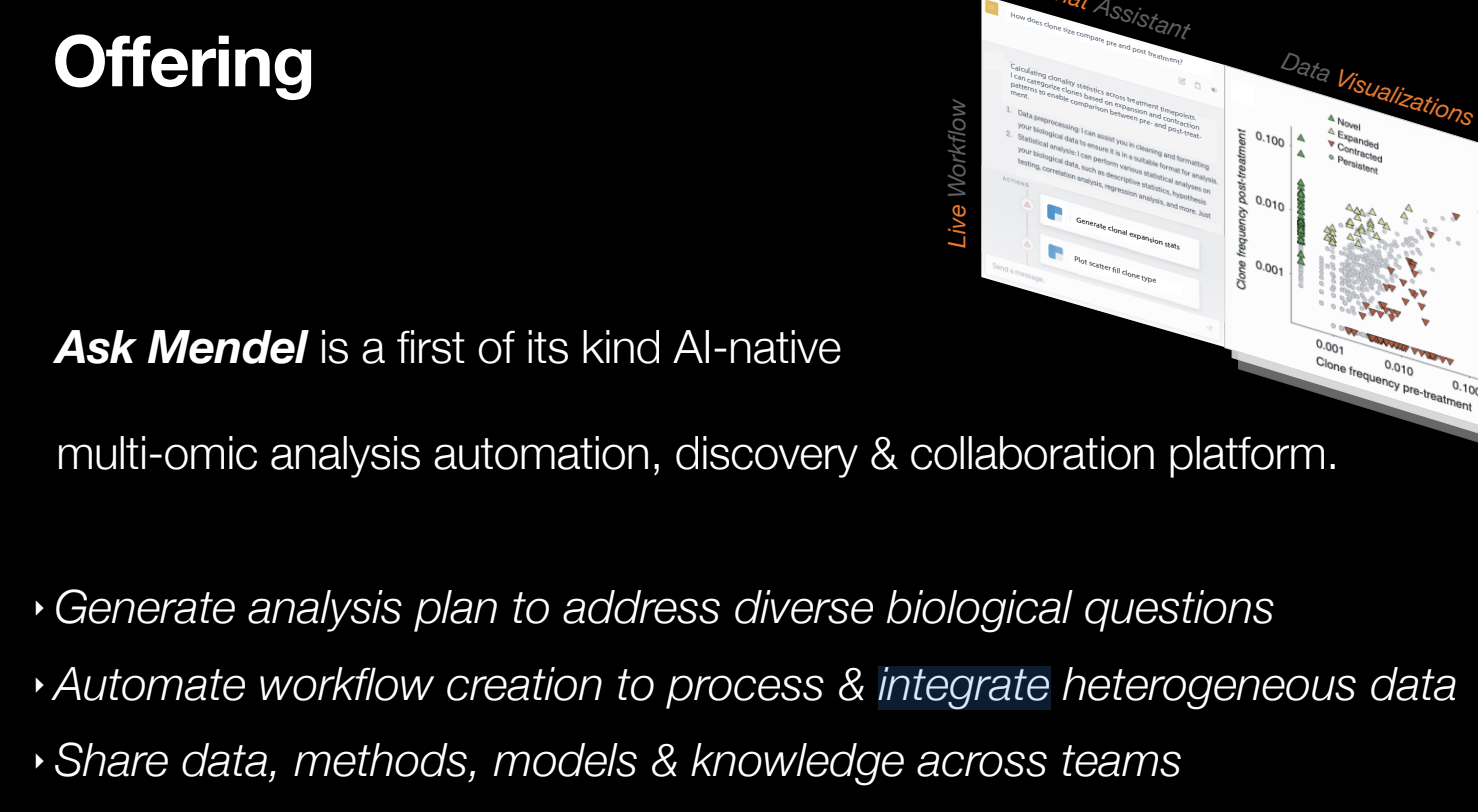
- Offering:
- Big Questions:
- How real is this techically, what are the problems, what are the barriers to someone else doing it?
- NSF proposal
- People
- Thomas Meschede Rose, a design automation expert and ML architect
- Come Raczy and Jesse Johnson would each bring 20 years of experience as renowned leaders of biotech software and data engineering
- UCSD faculty Drs. Ramamohan Paturi, Leon Bergen and Julian McAuley, visiting scholar Matthew Clegg, and selected UCSD graduate students, will bring expertise in personalized ML techniques and AI capabilities
- Dr. Randy Goebel (University of Alberta) would bring deep expertise in explainable AI and automated reasoning
- For Dec 12th, 2023 meeting
- LLM AI is great but has known weaknesses; our Special Sauce is to make up for those by good UI design.
- Crowded field of competitors! And a lot of slick-looking UIs. What is plan to compete (for the market, not NSF)
- Randy Gobbel confusion
- BioBike story
- What are the real problems to be solved on the AI side?
- Maybe relevant
- [[2112.02969] Jigsaw: Large Language Models meet Program Synthesis](https://arxiv.org/abs/2112.02969)
- omigod a lot of stuff Jigsaw: Large Language Models meet Program Synthesis
- 2021 paper, from Stanford + Microsoft India
- Targets Pandas API
- Some attention to UI "multimodal". Emph on test cases, which is good.
- cites AutoPandas framework with is example-driven, should check that out.
- it's a "graph neural net"
- Also BluePencil
- Codex model is trained on code (everybody is doing this shit)
- From Words to Code: Harnessing Data for Program Synthesis from Natural Language
- from Microsoft
- use the data context in the prompt
- semantic reranking: which I think is, they look at the output to see if it makes sense as code?
- that is "semantic filtering", but there is also "semantic reranking" which tries to achieve diversity in the answer set.
- "in-context learning" important but I can't figure out what it means.
The second parameter is the temperature which is a value between 0 and 1 (both inclusive). A lower temperature value makes the model behavior more deterministic (i.e. less variability in the answers returned by the model for the same input), whereas a high temperature makes the model take more risks and be "creative" in its response.
- AI for data analysis, non-bio
- Hal9: Get instant answers from your data with AI
- BioBike 2 UI concept (with AI). Sigh, ahead of time as usual
- Essential AI (just launched it appears)
- Second meeting upshot
- Sigh, didn't connect that well, probably because I am exhausted. He was disappointed that I am not an expert in explainable AI...sigh.
- Promised to work up some UI concept for him. He will send my figma drawings
- Ideas: just have the data be concretely present and actionable.
- Assaf, I felt our last meeting didn't go that well, probably because I've been pretty distracted with other things lately. Let me try to explain what I was trying to say: The problem with LLM generated code is that it is often wrong, buggy, or hallucinatory (eg it will make up functions). The key to making it useful despite these problems is good interaction design that permits the human user to easily detect and correct problems with generated code.
- Existing notebook UIs are not quite interactive enough. I'm thinking about something that really puts the concrete data front and center to make it clearer to the user what is going on, and also tracks provenance for repeatability. Typecell and VizierDB are new notebook-like UIs that are in this general direction, although I think there is room for improvement.
- I've got a long history with innovation in notebook-like UIs (the BioBike project was a web-based repl programming environment long before Juptyer existed), and feel like doing something new with them. I think it's a pretty good fit with your designs and it would be exciting to work together, but if you aren't interested, I may pursue the above ideas independently.