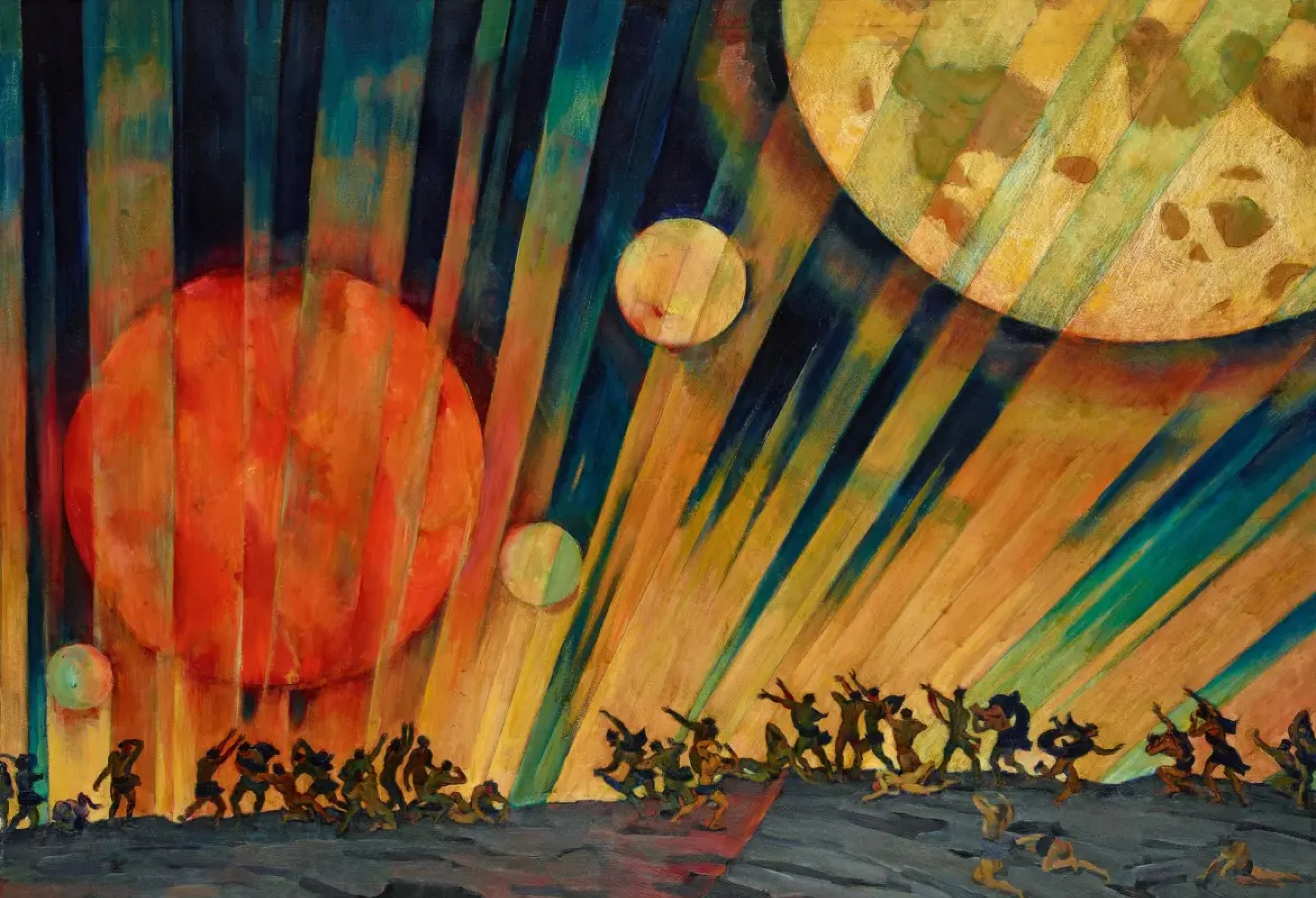
cosmism
10 Nov 2025 - 07 Aug 2026
- One of the many strange exhibits at Museum of Jurassic Technology is Dreams of Earth and Sky: The Ecstatic Journey of Konstantin Tsiolkovsky no web presence you have to go.
- Some connection to panpsychism.
As a professional—and successful—science fiction author, Stross says he’s “spent a lot of time lifting up the rocks in the garden of SF to look at what’s squirming underneath.” One of the slimy grubs he found there was cosmism. Tsiolkovsky didn’t just influence Clarke. Tsiolkovsky’s quote about Earth as the “cradle” we’re destined to outgrow has long been iconic among space enthusiasts and science fiction authors, a shibboleth and a whispered hope. Yet Tsiolkovsky didn’t just want humanity to go to the stars. Like Fedorov, he wanted humanity to reorder the cosmos, creating a rationalized universe devoid of anything natural. In this “utopia,” tasks would be assigned to different peoples based on the supposedly inherent aptitudes of their race, and the disabled would be killed. Imported across the Atlantic by rocketry enthusiasts and early science fiction authors, Tsiolkovsky’s cosmist vision of universal colonialism and eugenicsi meshed well with existing ideas in American culture, like Turner’s frontier thesis. This set the tone for American science fiction. “There was an implicit ideology attached to this strain of science fiction right from the outset: the American Dream of capitalist success, mashed up with progress through modern technology, and a side-order of frontier colonialism,” Stross writes. “There’s been a tendency in American SF, ever since those early days, to be willfully blind to the political implications of the shiny toys.” Instead, billionaires explicitly use science fiction as a blueprint—Musk even tweeted that “science-fiction should not be fiction forever!”—heedless of the intent or meaning of the works that they’re blindly emulating.40 “Did you ever wonder why the 21st century feels like we’re living in a bad cyberpunk novel from the 1980s?” Stross asks. “It’s because these guys [tech billionaires] read those cyberpunk novels and mistook a dystopia for a road map.
- Is this an accurate picture of cosmism? Ask Claude
- The passage makes a reasonable point about the genealogy of ideas, but it conflates several things worth separating:
- What's accurate:
- Tsiolkovsky did hold eugenicist views alongside his rocketry work
- There is a real ideological current in American SF connecting frontier mythology, technological optimism, and colonial logic
- Tech billionaires do explicitly cite SF as inspiration, sometimes uncritically
- What's overstated or muddled:
- The causal chain from Tsiolkovsky → American SF → Musk is asserted more than demonstrated. Ideas travel in complex ways; correlation isn't transmission
- Stross is essentially critiquing a genre he participates in and profits from, which creates obvious incentive to position his own work as the sophisticated exception
- The cyberpunk-as-dystopia point is somewhat self-serving. Gibson and others were ambivalent about their worlds, not straightforwardly warning against them
- Lumping "space enthusiasm" with eugenics via Tsiolkovsky risks guilt-by-association reasoning
- The deeper problem: The passage treats the origins of ideas as determinative of their current meaning, which is a genetic fallacy. Rocketry and space exploration emerged from many intellectual traditions simultaneously. The fact that one contributor held abhorrent views doesn't contaminate the entire enterprise.
- Stross is identifying something real about unreflective technological utopianism, but the historical argument is sloppier than it presents itself.