Jacob Foster
07 Mar 2023 - 16 Mar 2026
- co-director of DISI conf'
- Basing from Rota essay – which was good but not that earthshaking for me?
- Paper and ML dataset history: Reduced, Reused and Recycled: The Life of a Dataset in Machine Learning Research | OpenReview
- Kind of metascience
- Not sure why I care much about benchmarking, its a symptom of much more fundamental problems.
- real life is not discrete tasks (agree)
- Cultre, namechecks Dan Sperber and his theory of Cognitive Causal Chains (some kind of social representation – sounds sort of like memes, esp since the emphasis is on how they spread)
- Embedded vs Embodied – a spectrum with Bordieue on one end, Latour in the middle, others I don't know...seems a bit bs-y. Swidler's question 2001 – how some cultural elements contro/anchor others?
- ok he is trying to apply these ideas from cultural theory to LLMs. A stretch but interesting. "the cacophony question".
- Swidler's question, how some cultural elements organize others?
- Swidler is a big deal apparently Ann Swidler - Wikipedia
- TODO Dennett had a talk in this series, should watch.
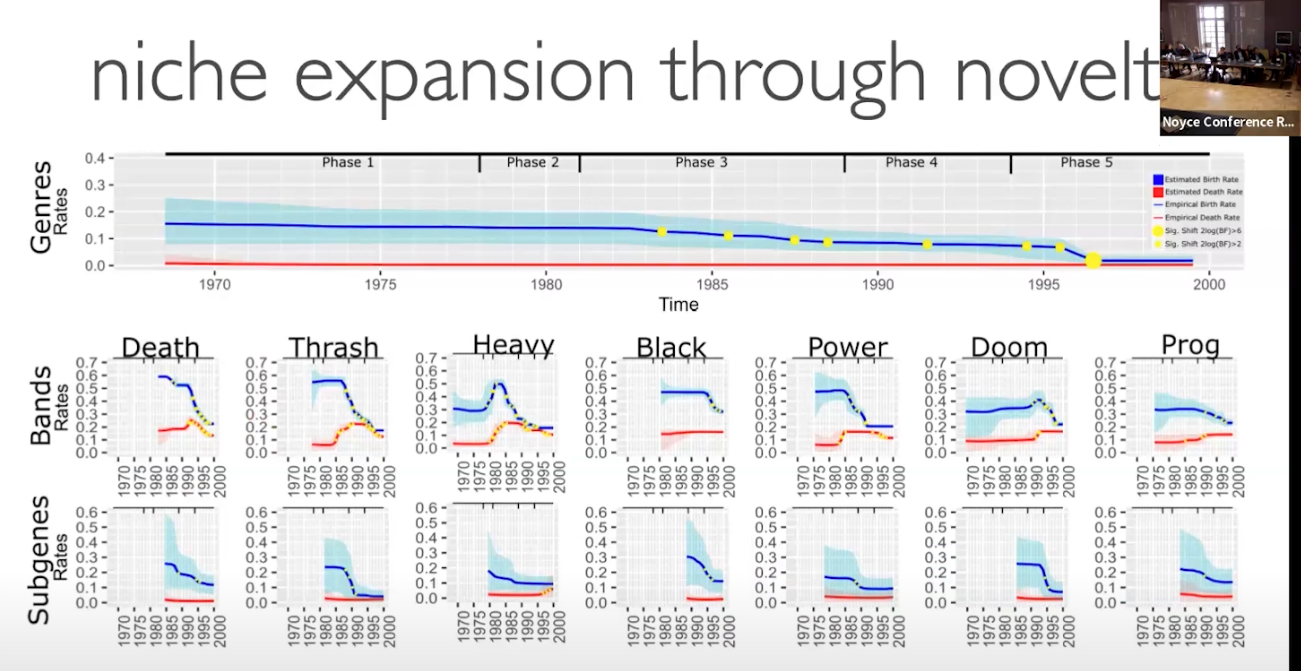
- Paper Evolutionary Dynamics of Cultural Change (him, Bernard Koch, et al)
- Evol of Metal Bands (cool as shit, I have to admit)
- Human brains and human artifacts are the environment in which cultural forms live.
- OK that is true but damn, that should not be a fresh insight in 48-pt type, it's fucking obvious.
- He is a Jungian and his theory of cultural forms is highly compatible (cites "luminous parasite" from WS guys).
- How does agency emerge from agents? OK he is on my turf.
- Models of creativity
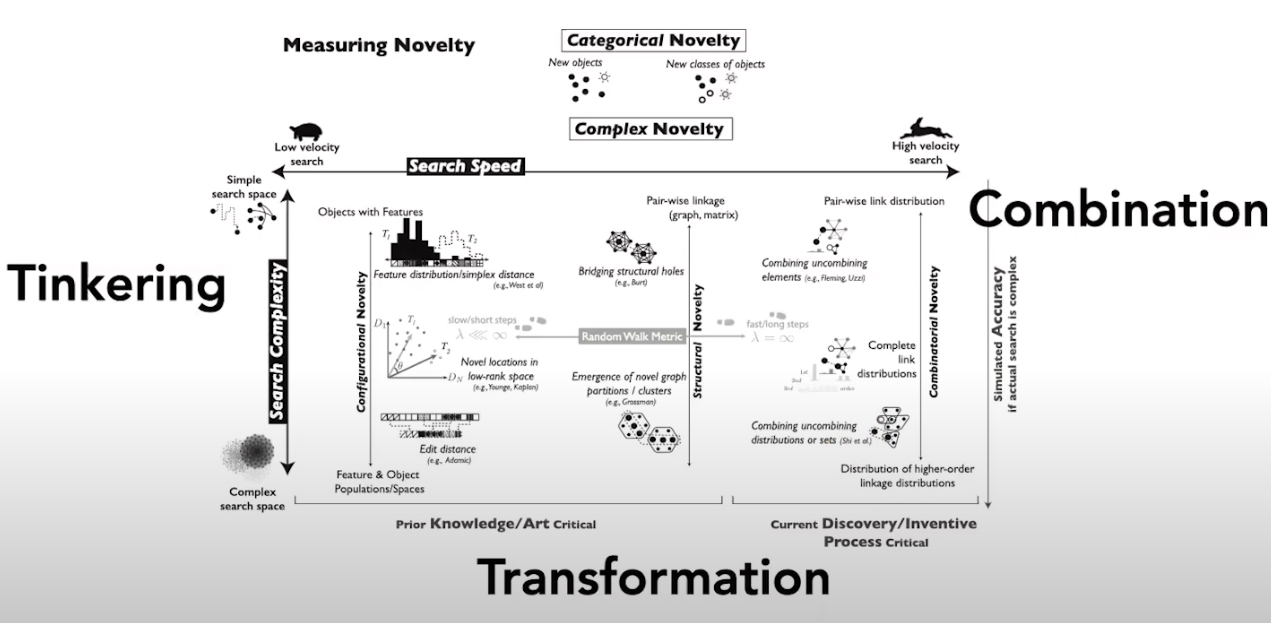
- "mostly animal cognition researchers"

- He spoke at 2019 Metascience Symposium Jacob Foster - Metascience 2019 Symposium Damn small world.
- Sperber and Thom Scott Phillips, "Ostension + Inference", never heard this before but it sounds very like the imaginative improvisation model that I already have. Hm.
- Ostension means "signalling signalhood" (?). ah ok, it doesn't mean "imaginitive", it is more like Batesonian meta signalling or Gricean implicature Relevance theory - Wikipedia.)
- Chuck Goodwin on communicative action (highly recommended)
- Fifth deconstruction, if O+I is right written language is going backwards, cites "Rosa's argument on gaols" from earlier, might need to check out
- Stories are important (and deficient in LLMs)
- Right meaning, Indiscrete Thoughts Rota, original Barrier of Meaning is Stan Ulam...
- when you perceive you perceive a function, not an object (true but also a well-trod trope, Gibson et al).
- Logic only formalizes a few processes (yes, obvious)
- Rota on Husserl Facticity (physics) and function
- Fundierung – founding
- He's organizing a conference on Mathematics of Intelligence with Josh Tenenbaum!
Physics
- [[1001.2485v2] Physics With Two Time Dimensions](https://arxiv.org/abs/1001.2485v2) (!)
An exchange on WS
JF: Getting into this a bit late, but I did want to underscore that there has long been a vaguely Platonic current in contemporary biology (often coming from those with a more developmental or “evo-devo” orientation) that, if not explicitly anti-Darwinian, certainly sees itself as opposing the excesses of strong adaptationists (think a cartoon version of Richard Dawkins, who is already kind of a cartoon at this point). D’Arcy Thompson is probably the most famous exponent, but you can see the same current in, say, Turing’s work on pattern formation, Stu Kauffman’s work on random Boolean networks, etc. Anyone drawing attention to “order for free,” often with an emphasis on the role of physical principles, self-organization, and deep mathematical structures. Mike Levin has recently come out hard in this direction (see for example Forms of life, forms of mind | Dr. Michael Levin | Platonic space: where cognitive and morphological patterns come from (besides genetics and environment) and we’re planning to chat soon about the (re) emergence of the Platonic paradigm in science.
- No doubt I am confused, but to my mind people like Thompson and Maturana/Varela and Turing (in his pattern work) aren't Platonists in the hard sense, just because they consider form and the emergence of form. There's nothing there that requires thinking that forms are fixed, eternal, and somehow prior or more fundamental than material reality. There's also nothing there that conflicts with adaptationism and Darwinism, although maybe those end up getting de-emphasized.
- The Platonism that Mayr said held back biology for a couple of millenia was the idea that there was a fixed ideal form for a species, which is pretty obviously wrong. It emphasized essentialism as opposed to variation across populations. Darwinism didn't eliminate the idea of form, just a wrong idea about the relationship of forms to material reality.
- I will have to read the Levin article in more detail, on a skim I found it frustrating because while I actually think I agree with him basically (eg, that there are mathematical attractors and it make ssense to think of them as extering a kind of causality) the whole talk of a separate world from which there are "ingressions" gives me hives. I guess my background assumption is that dualism is the root of all evil, Plato is one of roots of that view, and Darwinism and cybernetics have freed us from it. I am willing to question those assumptions but it is an ongoing struggle.